
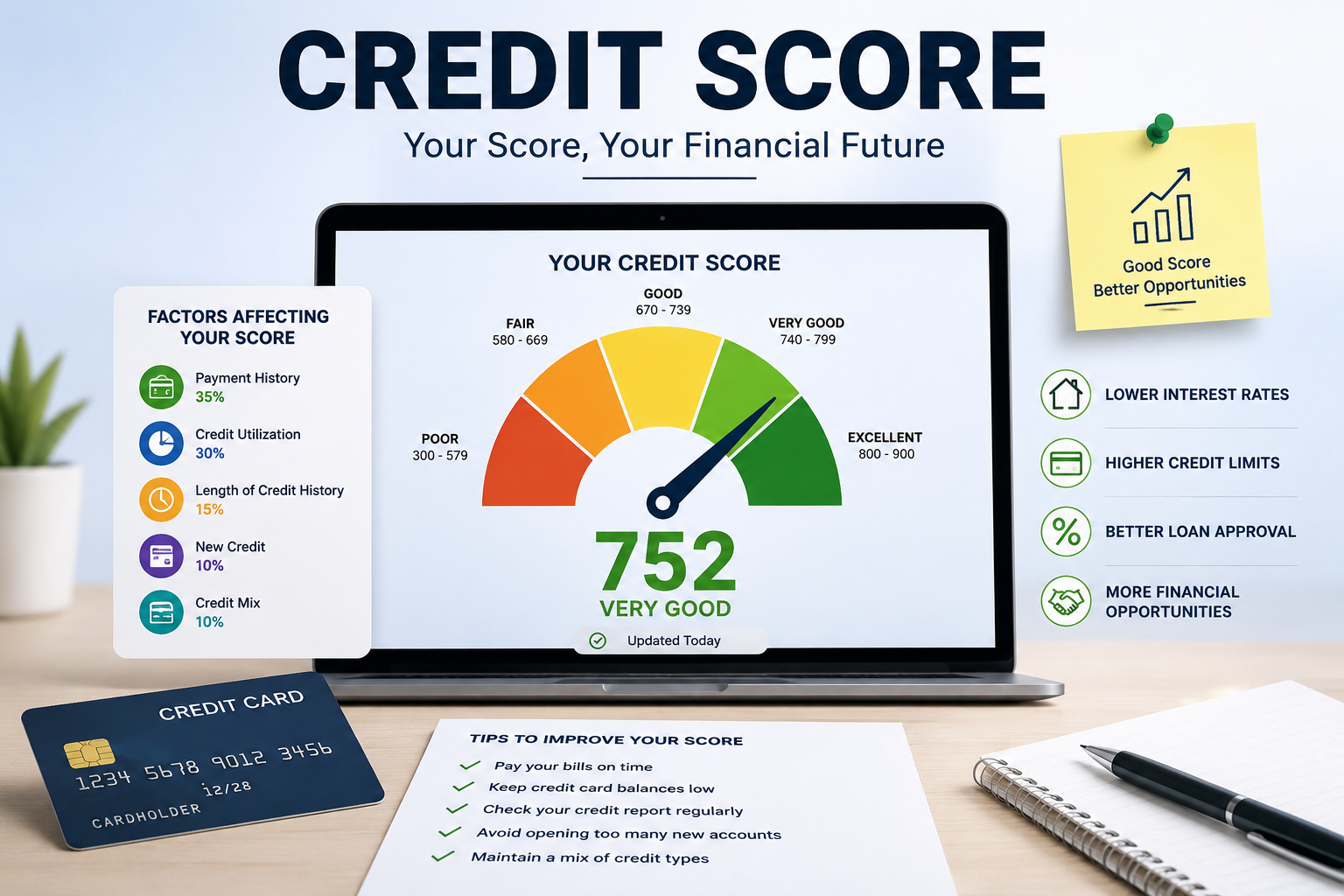
Your credit score affects far more than just loan approvals. It can influence your interest rates, insurance premiums, rental applications, and even some job opportunities. Yet many people have only a vague idea of what actually moves the number up or down.
This guide breaks down exactly what affects your credit score, clears up common myths, and gives you a practical plan to start improving it this year.
What Is a Credit Score and Why It Matters
A credit score is a numerical summary of how reliably you manage borrowed money. Lenders use it to decide whether to approve you for credit and what interest rate to offer. A higher score generally means lower interest rates, better loan terms, and easier approvals.
In most markets, scores range from around 300 to 900, with higher numbers reflecting lower risk to lenders. In India, this score is commonly referred to as a CIBIL score, issued by credit bureaus like TransUnion CIBIL, Experian, Equifax, and CRIF High Mark. In the United States, FICO and VantageScore are the most widely used models. While the exact scoring formulas differ, the core factors that influence your score are strikingly similar across markets.
What Actually Affects Your Credit Score
Understanding the real drivers behind your score helps you focus your effort where it counts.
Payment History
This is typically the single biggest factor. Paying bills on time, every time, has the largest impact on your score. Even one missed payment can cause a noticeable drop, and the effect can linger for months or years.
Credit Utilization
This refers to how much of your available credit you are using. Maxing out a credit card, even if you pay it off in full each month, can hurt your score if the balance is high at the time it is reported. Keeping utilization low relative to your credit limit signals responsible borrowing.
Length of Credit History
The longer your accounts have been open and in good standing, the better. This is one reason closing your oldest credit card is often not a good idea, even if you rarely use it.
Credit Mix
Having a mix of credit types, such as a credit card, a car loan, and a personal loan, can slightly improve your score by showing you can manage different kinds of credit responsibly. This factor matters far less than payment history and utilization.
New Credit Inquiries
Applying for several new credit products in a short window can temporarily lower your score and signals higher risk to lenders. Each hard inquiry stays on your report for a period of time, even if the application is approved.
Step-by-Step Plan to Improve Your Score
Step 1: Check Your Credit Report for Errors
Start by pulling your credit report from the relevant bureau in your country. Look for:
- Accounts that are not yours
- Incorrect late payment marks
- Outdated balances
- Duplicate accounts
Errors are more common than most people expect, and disputing them can lead to a quick score improvement once corrected.
Step 2: Set Up Autopay for Every Bill
Since payment history carries the most weight, automating at least the minimum payment on every credit account removes the risk of accidentally missing a due date. You can always pay more manually, but autopay acts as a safety net.
Step 3: Lower Your Credit Utilization
Aim to keep your utilization below 30 percent of your total available credit, and ideally under 10 percent for the strongest results. You can lower utilization by:
- Paying down existing balances
- Requesting a credit limit increase, without increasing your spending
- Making multiple smaller payments throughout the month instead of one lump sum at the due date
Step 4: Avoid Closing Old Credit Accounts
Even if you rarely use an old card, keeping it open helps preserve your length of credit history and your overall available credit. Consider making a small recurring purchase on it, such as a subscription, and paying it off automatically to keep it active.
Step 5: Be Strategic About New Credit Applications
Only apply for new credit when you genuinely need it. If you are planning a major purchase like a car or home loan, avoid applying for other credit products in the months leading up to it, since inquiries and new accounts can temporarily lower your score right when you need it highest.
Step 6: Diversify Responsibly, Not Artificially
Do not open unnecessary loans or credit lines purely to improve your credit mix. The impact is minor compared to the risk of taking on debt you do not need.
Step 7: Monitor Your Score Regularly
Many banks and financial apps now offer free credit score tracking. Checking your own score, known as a soft inquiry, does not hurt your score and helps you catch problems early.
Common Credit Score Myths
- “Checking your own score hurts it.” False. Soft inquiries from checking your own report do not affect your score.
- “Closing a credit card improves your score.” Usually the opposite. It can shorten your credit history and raise your utilization ratio.
- “You need to carry a balance to build credit.” False. Paying your balance in full each month still builds a strong payment history, without wasting money on interest.
- “Income affects your credit score.” Your income is not a direct factor in most scoring models. What matters is how you manage the credit you have.
- “A good score means you will always get approved.” Lenders also weigh income, existing debt, and their own internal risk criteria, so a high score improves your odds but does not guarantee approval.
How Long Does It Take to See Improvement
Timelines vary depending on your starting point and what needs fixing.
- Correcting a report error can improve your score within a few weeks of the dispute being resolved.
- Lowering credit utilization often shows results within one to two billing cycles.
- Building payment history takes longer, typically several months to a year of consistent on-time payments to see a meaningful shift.
- Recovering from a major negative mark, such as a missed payment or default, can take one to several years, though the impact fades over time as long as your subsequent behavior stays consistent.
Patience matters here. Credit scores reward consistency over time, not quick fixes.
A Simple Monthly Checklist
- Confirm autopay is active on every credit account.
- Check your current utilization percentage and pay down balances if needed.
- Review your credit report for any new errors.
- Avoid applying for new credit unless necessary.
- Track your score through a free monitoring tool.
- Keep old accounts open and lightly active.
Bottom Line
Improving your credit score in 2026 is less about finding a clever trick and more about building consistent, boring habits: pay on time, keep balances low, and be selective about new credit. Small, steady actions compound into a significantly stronger score over time, opening the door to better interest rates, easier approvals, and more financial flexibility.
Start with the checklist above this month, and revisit your report in 90 days to track your progress.
Disclaimer: This article is for educational purposes only and does not constitute financial advice. Credit scoring models vary by country and provider. Consider checking with your local credit bureau or a licensed financial advisor for guidance specific to your situation.