
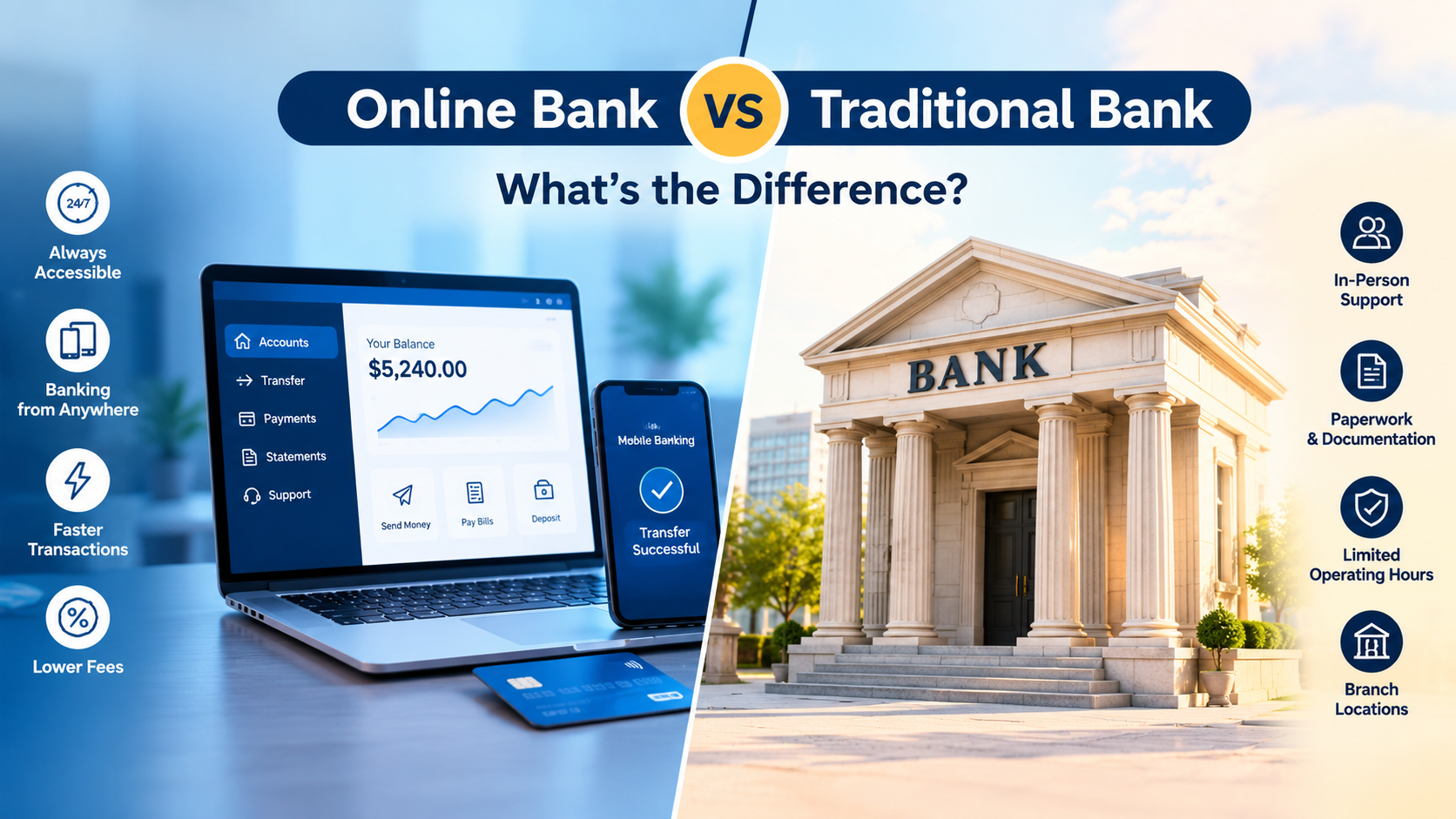
A few years ago, opening a bank account meant taking half a day off work, carrying a folder of photocopies, and waiting in a queue to meet someone behind a counter. Today, you can open an account from your sofa in about ten minutes using nothing but your phone. That shift has left a lot of people asking the same question: should I stick with a traditional bank, or move to an online bank?
The honest answer is that neither is better for everyone. The online bank vs traditional bank debate really comes down to how you live, how you handle money, and what you expect from the place that holds your savings. In this guide, we will break down how both types of banks work, where each one wins, where each one falls short, and how to decide which is right for you.
What Is a Traditional Bank?
A traditional bank, sometimes called a brick-and-mortar bank, is the kind most of us grew up with. It has physical branches, ATMs, tellers, and relationship managers. You can walk in, sit down with a person, and get things done face to face. Most large and long-established banks fall into this category, and almost all of them now also offer net banking and a mobile app on top of their branch network.
The biggest strength of a traditional bank is the human element. If you are taking a home loan, setting up a fixed deposit for a parent, or sorting out a problem with a large transaction, being able to speak to someone in person can feel reassuring. Branches also make it easier to handle cash-heavy tasks, such as depositing bundles of notes for a small business or getting a demand draft made.
The trade-off is cost and speed. Running hundreds of branches is expensive, and those costs often show up in the form of lower interest rates on savings, higher minimum balance requirements, and a slower approach to new technology. Paperwork can also take longer, especially for account opening and loan approvals.
What Is an Online Bank?
An online bank, often called a digital bank, operates mainly or entirely through websites and mobile apps. There is no need to visit a branch for most tasks. You open your account online, complete your KYC through a video call or Aadhaar-based verification, and manage everything from your phone, including transfers, bill payments, deposits, and card controls.
Because these banks do not carry the expense of a huge branch network, they can pass some of the savings on to customers. That usually means better savings account interest rates, lower or zero maintenance fees, and cleaner, easier-to-use apps. Customer support tends to happen through chat, email, or phone instead of in person.
One thing worth clarifying, especially in India: many of the apps people call “digital banks” or neobanks are not actually banks themselves. They are financial apps that work in partnership with a licensed bank, which is the one that really holds your money. Others, like the digital-first accounts offered by established banks, are full banking products with an app-first experience. Always check which licensed bank sits behind the app before you deposit anything. This one habit protects you far more than any feature comparison.
Online Bank vs Traditional Bank: Key Differences
1. Convenience and Access
Online banking wins on convenience for everyday tasks. You can check your balance at midnight, pay a bill from a train, or freeze a lost card in seconds without calling anyone. Account opening is also far quicker, often finishing in a single sitting.
Traditional banks are catching up with their own apps, but their strength is physical access. If you regularly handle cash, need in-person document services, or simply feel more comfortable speaking to someone at a counter, a branch nearby is a real advantage. Convenience is personal, so think about which tasks you actually do most often.
2. Fees and Charges
Online banks are generally more relaxed about fees. Many offer zero-balance or low-balance accounts, free virtual debit cards, and minimal charges on transfers. Since they have lower overheads, they do not need to earn as much from account maintenance.
Traditional banks often require a monthly or quarterly average balance and may charge a penalty if you fall short. They can also charge for things like demand drafts, cheque books beyond a certain limit, and extra ATM transactions. That said, some traditional banks waive these charges for salary accounts or premium customers, so it is worth asking what applies to your profile. Always read the fee schedule before opening any account, because small charges add up over a year.
3. Interest Rates on Savings
This is where many people feel the biggest difference. Online and digital-first banks, along with some small finance banks, often advertise higher savings account interest rates and better returns on fixed deposits than large traditional banks. On a small balance, the gap may not seem like much. On a larger balance kept for years, it can be meaningful.
Rates change often and depend on the bank, the deposit amount, and RBI policy, so treat any number you see in an article as a starting point and check the bank’s current rate on its official website. Also, a higher rate is only attractive if the bank is safe, which brings us to the next point.
4. Safety and Security
This is the question that worries people most, and it deserves a careful answer. In India, banks that hold a licence are regulated by the Reserve Bank of India, and deposits in most banks are insured through DICGC up to ₹5 lakh per depositor per bank. That protection applies whether you use a branch or an app, as long as the institution is a licensed bank covered by the scheme.
The real difference is in the type of risk. With a traditional bank, the risk that people worry about is fraud at branches or with cheques. With an online bank, the risk is mostly digital: phishing, fake apps, SIM swap fraud, and weak passwords. Good digital banks use strong encryption, two-factor authentication, and instant alerts. You can lower your own risk by using a unique password, never sharing OTPs, installing apps only from official stores, and turning on transaction alerts.
5. Customer Service
A traditional bank lets you sit across from a real person, which is comforting when something goes wrong. The downside is that branches have fixed hours, and you may wait in line even for small requests.
Online banks usually offer round-the-clock chat or app-based support, and simple issues often get solved fast. Where they can struggle is with complicated problems, because you may be routed through automated responses before reaching a person. If good support matters to you, read recent user reviews and look at how quickly a bank resolves disputes.
6. Range of Services
Traditional banks usually offer the widest range of products under one roof: savings and current accounts, home loans, car loans, business loans, locker facilities, wealth management, insurance, and more. If you want a single relationship for all your financial needs, this is a strong point.
Online banks tend to focus on doing the basics very well, such as savings accounts, payments, cards, deposits, and sometimes personal loans or investments. The product range is growing, but it may still be narrower. Also, some services, like safe deposit lockers, are simply not possible without a physical branch.
7. Technology and User Experience
Digital banks are usually built around the app, so the experience feels modern and simple. Expense tracking, spending insights, instant card controls, and easy UPI payments are often built in from day one.
Traditional banks have improved their apps a lot, but some still feel heavy or confusing because they were built on older systems. If you spend most of your banking time on your phone, this difference will matter to you every day.
Pros and Cons at a Glance
Online Bank
- Pros: Higher interest rates on average, low or no maintenance fees, fast account opening, user-friendly apps, 24/7 access.
- Cons: No or limited branches, harder to handle cash, support can feel impersonal, fewer product types, more exposure to online fraud if you are careless.
Traditional Bank
- Pros: Physical branches and ATMs, in-person support, wide range of products, easy cash deposits, strong brand trust.
- Cons: Lower interest rates in many cases, higher fees and minimum balance rules, slower processes, and sometimes outdated apps.
Who Should Choose an Online Bank?
An online bank suits you if you are comfortable with smartphones, rarely deal with cash, and want to earn more on your savings without paying extra fees. It is a great fit for young professionals, freelancers, students, and anyone who wants a simple second account for savings or for keeping money separate from daily spending. It also works well if you value speed and do not want to visit a branch for routine tasks.

Who Should Choose a Traditional Bank?
A traditional bank makes more sense if you prefer face-to-face service, handle regular cash deposits, run a small business, or need bigger financial products like a home loan or a locker. It is also a comfortable choice for older family members who are not used to apps, or for anyone who simply values having a physical place to go when something goes wrong.
Can You Use Both?
Yes, and for many people this is the smartest answer to the online bank vs traditional bank question. A common setup is to keep your main salary or long-term account with a traditional bank for loans, cash needs, and stability, then open a digital account for everyday spending, quick savings, or earning better interest on spare money. This way, you get the reliability of one and the convenience of the other. Just make sure you keep track of both accounts and maintain any required balance so you do not pay unnecessary charges.
How to Choose the Right Bank: A Quick Checklist
Before opening any account, run through these questions:
- Is the bank licensed and regulated by the RBI, and are its deposits covered by DICGC?
- What are the minimum balance requirements and other regular charges?
- What is the current savings account interest rate, and how is it paid?
- How good are the mobile app and net banking experience based on recent reviews?
- How can you reach customer support, and how fast do they usually respond?
- Do you need branch access, cash deposit facilities, or loan products?
- Are there useful extras like cashback cards, UPI features, or rewards that match how you spend?
Answering these honestly will narrow your options much faster than comparing every feature on paper.
Frequently Asked Questions
Is an online bank safe?
Yes, provided it is a licensed bank regulated by the RBI, or a digital service backed by one. Deposits in covered banks are insured up to ₹5 lakh per depositor per bank. Your own habits matter too, so use strong passwords and never share your OTP.
Do online banks give higher interest than traditional banks?
Often they do, since they spend less on running branches. Rates change frequently, so compare the latest figures on each bank’s official website before deciding.
Can I deposit cash in an online bank?
This depends on the bank. Some allow cash deposits through partner ATMs or CDMs, while others do not support it easily. If you deal with cash regularly, check this before opening the account.
Are neobank apps the same as online banks?
Not always. Many neobanks are financial apps that partner with a licensed bank. Always confirm which bank actually holds your money.
Is it a good idea to have accounts in both types of banks?
For many people, yes. A traditional account can handle loans and cash needs while a digital account handles daily spending and savings.
Final Thoughts
The difference between an online bank and a traditional bank is not really about which one is modern and which one is outdated. It is about what fits your routine. Online banks usually give you better rates, lower fees, and a smoother app experience. Traditional banks give you physical access, human support, and a wider range of services. If you value speed and savings, lean digital. If you value personal service and full-scale financial products, a traditional bank still earns its place.
Whichever you choose, do a little homework first. Check that the bank is regulated, read the fee details, and compare current rates. A few minutes of research now can save you real money and stress later.