
You have a strong idea, a growing customer base and a clear plan for how extra money would help. You need funds to buy equipment, hire staff, build stock or open a second location. So you apply for a business loan, and a few weeks later you get a polite rejection letter. It stings, and it often leaves owners confused about what went wrong.
Here is the encouraging part. Most business loan rejections come down to a handful of fixable issues. Lenders are not trying to say no. They are trying to find out whether your business can repay the money, and your job is to make that answer easy to see. In this guide, we walk through how to improve your business loan approval chances with practical steps you can start right away.
How Lenders Decide on a Business Loan
Before you fix anything, it helps to think like a lender. A bank or online lender has one core question: if we lend this business money, will we get it back with interest? To answer it, they look at several things.
They study your business cash flow to see whether there is enough money coming in to cover repayments. They check your credit history, both personal and business. They review how long you have been operating and how stable your revenue looks. They also look at your existing debts and whether you can offer collateral as backup. Many lenders sum this up in a simple idea known as the five Cs of credit: character, capacity, capital, collateral and conditions.
When you understand this, every step below makes more sense. Each one is really about proving that you are a safe bet.
Step 1: Know Exactly Why You Need the Money
Lenders like clear purposes. A vague request such as “I need working capital” raises questions. A specific request such as “I need $40,000 to buy a commercial oven that will raise production by 30 percent” is much stronger.
Before you apply, write down what the money is for, how much you need and how it will help the business earn more. Get quotes from suppliers if you are buying equipment or stock. This shows you have done your homework and that the loan has a direct link to future income. It also helps you choose the right type of loan, whether that is a term loan, a line of credit or equipment financing.
Step 2: Build a Clear and Realistic Business Plan
A business plan does not need to be long, but it does need to be convincing. For an established business, it should explain what you sell, who your customers are, how you earn money and where you want to be in the next few years.
Include simple financial projections for the next one to three years, and explain the assumptions behind your numbers. Lenders can spot wildly optimistic forecasts instantly. A realistic plan that shows steady growth builds far more trust than a plan promising to double revenue overnight. For a new business, the plan matters even more, because you have less history to lean on.
Step 3: Keep Your Financial Records Clean and Up to Date
Messy books are one of the most common reasons loan applications stall. Lenders usually ask for several documents, and having them ready makes you look organized and serious.
Typically, you should be ready with:
- Profit and loss statements for the last two to three years
- Balance sheets
- Business bank statements for the last six to twelve months
- Business and personal tax returns
- A list of current debts and monthly payments
- Accounts receivable and payable summaries
If you do your own bookkeeping, consider using accounting software or hiring a bookkeeper before you apply. Clean, consistent records make it easier for the lender to see your strengths, and they reduce the chance of questions or delays.
Step 4: Strengthen Your Cash Flow
Cash flow is the lifeblood of a business, and lenders care about it more than almost anything else. Profit on paper is not enough. They want to see that real money flows in regularly and covers your costs and loan payments.
Many lenders measure this with the debt service coverage ratio, or DSCR. It compares your annual operating income to your total annual debt payments. For example, if your business earns $60,000 a year after operating costs and your total yearly loan payments would be $40,000, your DSCR is 1.5. Many lenders like to see a figure of 1.25 or higher, though requirements vary.
To improve cash flow, collect unpaid invoices faster, negotiate longer payment terms with suppliers, trim unnecessary spending and avoid tying up too much money in slow moving stock. Even a few months of healthier cash flow before you apply can change how your application looks.
Step 5: Check and Improve Your Credit Scores
For small businesses, the owner’s personal credit often matters as much as the company’s own credit. Lenders know that in a small firm, your personal habits reflect how you handle money.
Get copies of your personal credit report and, if available, your business credit report. Look for errors, old accounts that were never closed properly and late payments you can explain. Dispute anything that is wrong. Then focus on the basics: pay every bill on time, keep credit card balances low and avoid opening new credit lines right before applying.
If your business has no credit history yet, start building one. Open a business bank account, get a business credit card if you can manage it responsibly, and pay suppliers on time. Over time, this creates a track record that lenders can see.
Step 6: Separate Business and Personal Finances
Mixing personal and business money is a red flag for lenders. It makes your records confusing and makes it harder to judge how the business is really performing.
Open a dedicated business bank account and run all business income and expenses through it. Pay yourself a regular salary or draw rather than dipping in whenever you like. Registering your business formally, such as a limited company or LLC where available, can also protect your personal assets and add credibility. Clean separation shows professionalism, and it makes your financial story much easier to tell.
Step 7: Reduce Your Existing Debt
If your business already carries a lot of debt, lenders may worry about adding more. They look at how much of your income is already committed to repayments.
Where possible, pay down small loans and high interest balances before you apply. Avoid taking on new debt in the months leading up to your application. If you have several loans with high payments, speak to a lender about consolidating them into one with a lower monthly cost. A lighter debt load leaves more room in your cash flow, and that is exactly what a lender wants to see.
Step 8: Offer Collateral or a Personal Guarantee When Needed
Collateral is an asset that you pledge as security for the loan. It could be property, equipment, vehicles, inventory or unpaid invoices. If you cannot repay, the lender can take the asset to recover their money.
Offering collateral lowers the lender’s risk, which can improve your chance of approval and may even lower your rate. Some lenders also ask for a personal guarantee, which means you promise to repay from your own pocket if the business cannot. Think carefully before agreeing, because it puts your personal assets at risk. If you are uncomfortable with that, look at lenders who offer unsecured options, although these often cost more.
Step 9: Choose the Right Lender and Loan Type
Not every lender suits every business. Traditional banks usually offer the lowest rates, but they have strict rules and often prefer businesses that have been running for two years or more. Online lenders can be faster and more flexible, but their rates are often higher. Credit unions, community lenders and government backed programs may offer friendlier terms for small businesses in many countries.
Match the loan to your need. A term loan suits a one time purchase, a line of credit suits ongoing cash needs, and equipment financing uses the equipment itself as security. Applying to a lender that does not fit your profile wastes time and can leave unnecessary marks on your credit report. Do some research first, and ask lenders what they look for before you apply.
Step 10: Prepare a Complete and Honest Application
Small mistakes can sink a good application. Fill in every field carefully, make sure names and numbers match across all documents, and double check that nothing is missing. Incomplete applications are slowed down or rejected quickly.
Be honest about your situation. If you had a bad year, explain what happened and what you changed. Lenders appreciate transparency, and they will find the facts in your records anyway. If you can, build a relationship with a loan officer before you apply. Someone who already understands your business can speak up for you inside the lender.
Common Mistakes That Hurt Your Chances
Some errors appear again and again. Applying for more than you can realistically repay is one. Applying to many lenders at the same time is another, since multiple hard credit checks can lower your score. Hiding existing debts, submitting outdated documents and having no clear purpose for the funds also hurt. Finally, waiting until you are in desperate need is risky. Lenders can sense desperation, and you will have less time to fix problems. It is wise to apply when your business is healthy, not when it is struggling.
What to Do If Your Application Is Rejected
A rejection is a setback, not a final verdict. Ask the lender for the specific reasons. They are often willing to explain, and many regions require them to give you a reason.
Use that feedback to fix the weak spots. It might be low cash flow, too much debt, thin credit history or missing paperwork. Give yourself a few months to improve, then apply again. You can also explore alternatives such as a smaller loan, a different lender, invoice financing or a co-signer. Sometimes a smaller amount now builds the track record you need for a larger one later.
Conclusion
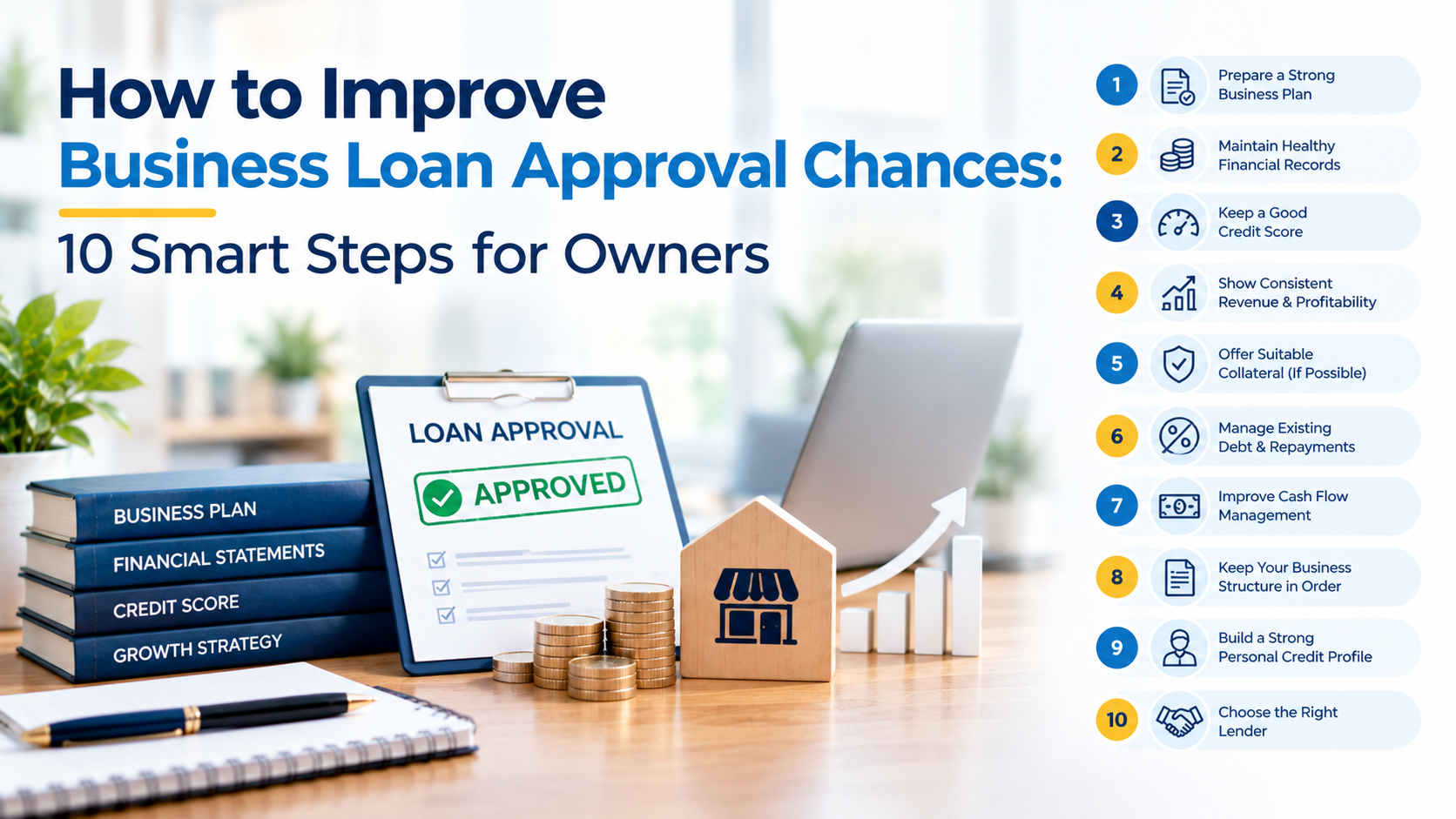
Improving your business loan approval chances is mostly about preparation and proof. Know why you need the money, build a realistic plan, keep your records clean and strengthen your cash flow. Look after your credit, separate your personal and business finances, manage your existing debt and consider offering collateral. Then choose the right lender and submit a complete, honest application.
None of these steps requires special connections. They need time and consistency. Start with one or two today, such as organizing your financial statements or pulling your credit report, and work through the rest over the coming weeks. When you finally apply, you will present a business that looks ready to grow and ready to repay. If this guide helped, share it with another business owner who is planning to borrow soon.