
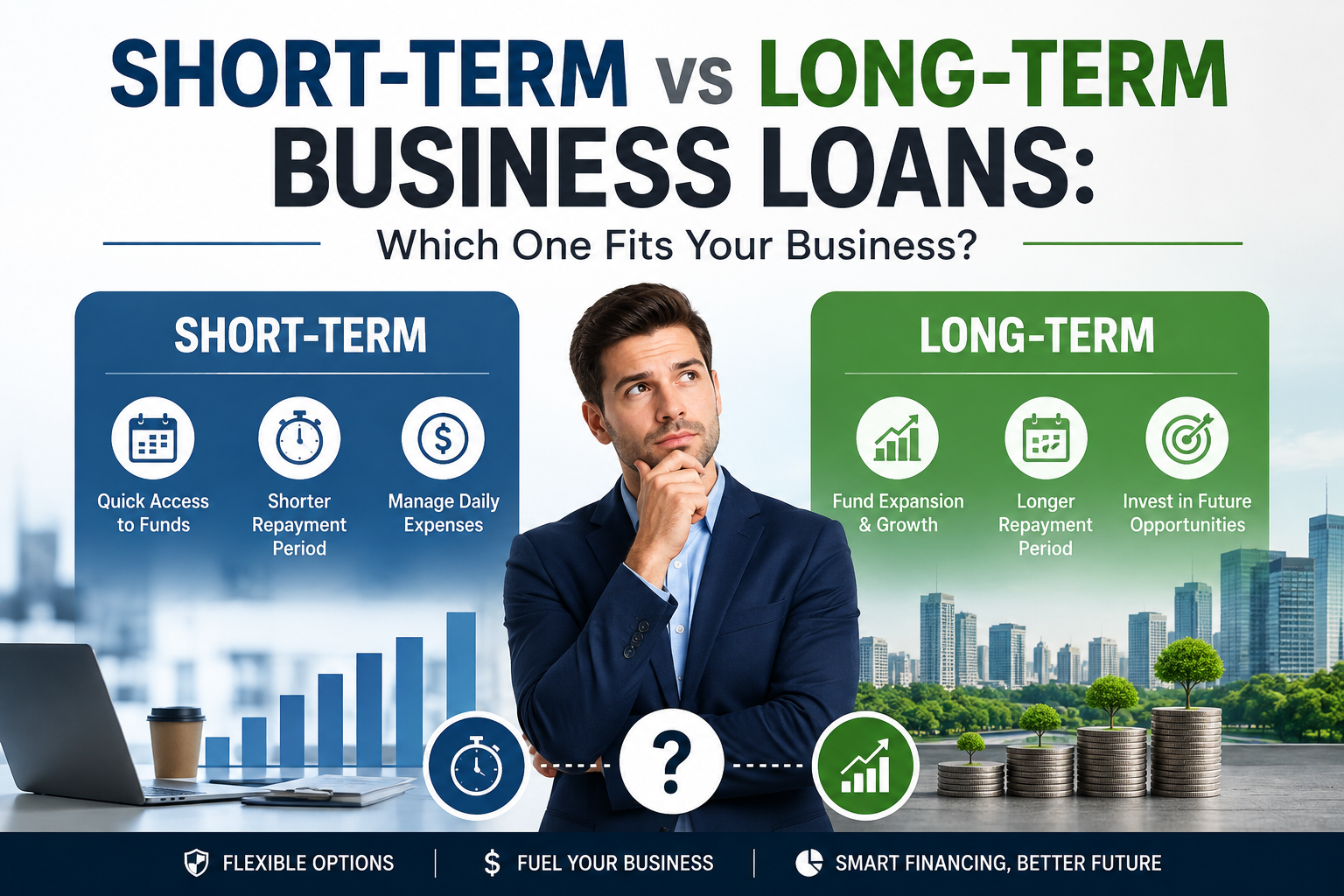
Every business owner hits a moment when cash is needed fast. Maybe a big order is coming in and you must buy stock first. Maybe a machine breaks down. Or maybe you have a chance to expand into a new location, and the price tag is far bigger than your savings. In each case, you reach the same question: should you take a short-term loan or a long-term loan?
It sounds like a small decision, but it can shape your cash flow for years. The wrong choice can leave you with payments that choke your monthly budget, or with a loan that costs far more than it should. The right choice gives you the money you need at a price your business can carry.
In this guide, we explain short-term vs long-term business loans in simple, practical language. You will learn how each type works, what each one costs, when each makes sense and how to match the loan to your goal. Let us start with the basics.
What Is a Short-Term Business Loan?
A short-term business loan is money you borrow and repay quickly, usually within three to eighteen months. Some lenders stretch the definition to two years, but the idea is the same. You get a lump sum, and you pay it back fast, often with daily, weekly or monthly payments.
Because the repayment window is short, these loans are built for immediate needs. Approval is also faster. Many online lenders can decide within a day and send the money within one to three business days. They often look more at your recent sales and bank activity than at your long credit history, which makes them easier to qualify for.
The trade off is cost. The amounts are usually smaller, the payments are larger relative to the loan, and the pricing can be high. Short-term loans are a useful tool, but they need care.
What Is a Long-Term Business Loan?
A long-term business loan is repaid over several years, commonly three to ten years, and sometimes up to twenty-five years for property. Banks, credit unions and government backed programs are the main sources.
These loans usually offer larger amounts, lower interest rates and smaller monthly payments, because the cost is spread over a longer period. They are used for big, lasting investments such as buying property, purchasing major equipment, expanding to a new site or acquiring another business.
The downsides are a slower and more demanding approval process. Lenders usually want to see a business that has been running for at least a year or two, strong credit, solid financial statements and often some collateral. You also stay in debt for longer, and over many years you can pay a lot of interest in total.
Short-Term vs Long-Term Business Loans: Quick Comparison
| Feature | Short-Term Loan | Long-Term Loan |
|---|---|---|
| Repayment period | 3 to 18 months (up to 2 years) | 3 to 10 years or more |
| Loan amount | Smaller | Larger |
| Approval speed | Fast, often within days | Slower, often weeks |
| Interest or pricing | Often higher | Usually lower |
| Payment size | Higher relative to the loan | Lower and easier to manage |
| Requirements | More flexible | Stricter, often needs collateral |
| Best for | Urgent or temporary needs | Big, lasting investments |
Keep this table in mind as we go deeper into each point.
How Repayment Works
Repayment is where the two loans feel most different in daily life.
With a short-term loan, payments come often and arrive fast. Some lenders collect daily or weekly, taking a small amount from your bank account each time. This can strain cash flow if you are not ready for it, even though each single payment looks small. You also finish quickly, which means you are free of the debt sooner.
With a long-term loan, you usually make one payment a month for years. The monthly figure is lower, so it is easier on your budget. But you are tied to the commitment for a long time, and your business needs to stay healthy enough to cover it through busy seasons and slow ones.
The Real Cost: A Worked Example
Numbers show the difference better than words. Let us compare costs in three simple cases.
Case 1: A short-term loan with a normal interest rate. You borrow $20,000 at 15 percent over 12 months. Your monthly payment is about $1,805, and the total interest is roughly $1,662. The loan is cleared in a year.
Case 2: A long-term loan on the same amount of money, spread out. Now look at a bigger project. You borrow $100,000 at 8 percent. Over five years, your payment is about $2,028 a month, and you pay around $21,658 in interest. Stretch the same loan to ten years, and the payment falls to about $1,213, but the total interest jumps to roughly $45,593. Over three years, the payment is higher at about $3,134, yet the interest is only about $12,811.
The pattern is clear. A longer term makes each payment lighter, but it makes the whole loan more expensive. A shorter term does the opposite.
Case 3: A short-term loan priced with a factor rate. Some short-term lenders do not quote an interest rate at all. They use a factor rate, such as 1.2. If you borrow $20,000 at 1.2, you repay $24,000. That sounds like a flat 20 percent cost. But if you repay it over six months, the effective annual rate works out to around 66 percent. This is why you should always ask for the APR, which shows the true yearly cost and lets you compare offers fairly.
Advantages of Short-Term Loans
Speed. When you need money this week, not next month, short-term lenders can deliver. This can save a deal or fix an emergency.
Easier approval. Newer businesses and owners with average credit often have a better chance, since lenders focus on current revenue.
Less interest over time. Even if the rate is high, the short duration means you pay interest for fewer months. Case 1 above shows that a one year loan costs a modest amount in total.
Quick path to being debt free. You close the chapter fast, which also frees your cash flow and your borrowing capacity.
Builds credit history. Repaying a short-term loan on time shows lenders you can handle debt, which can open doors to better financing later.
Disadvantages of Short-Term Loans
High effective cost. Some products, especially those using factor rates or fees, can be very expensive when converted to an annual figure.
Heavy payments. Because the loan is repaid fast, each payment takes a bigger bite out of your income. Daily or weekly collections can squeeze working capital.
Risk of a debt cycle. If a business borrows again to repay the first loan, it can end up in a loop of expensive borrowing. This is one of the biggest dangers.
Smaller amounts. You may not be able to borrow enough for large projects.
Advantages of Long-Term Loans
Lower rates. Banks and government backed programs often offer the cheapest financing, particularly to businesses with good records.
Smaller payments. Spreading the cost over years protects your monthly cash flow and leaves room for growth.
Large amounts. You can fund major projects such as buying a building, upgrading a factory or opening a second branch.
Predictability. Many long-term loans have fixed rates, so you know exactly what you owe each month. That makes planning and budgeting much easier.
Matching the loan to the asset. If you buy something that lasts ten years, it makes sense to repay it over a similar period, so the asset earns while you pay.
Disadvantages of Long-Term Loans
Slow approval. Expect more paperwork, deeper checks and a wait of weeks, or even months for some government backed loans.
Strict requirements. Lenders often want years of business history, strong credit, financial statements and collateral. A personal guarantee is common.
More total interest. The longer you borrow, the more interest you pay overall, even at a lower rate.
Less flexibility. Your business is committed for years. If revenue drops, the payments still need to be made. Some loans also charge penalties if you pay them off early.
When a Short-Term Loan Makes Sense
Short-term loans work best for needs that are temporary and that will pay for themselves quickly. Typical examples include:
- Buying extra stock before a busy season, such as a holiday rush
- Covering payroll or bills while you wait for customers to pay invoices
- Fixing or replacing a small piece of equipment quickly
- Taking up a limited-time supplier discount
- Handling an unexpected expense that would otherwise stop operations
Here is a simple story. Sara runs a gift shop. In October she needs $15,000 of extra stock for the holiday season. She knows sales from November and December will repay the loan comfortably. A six to nine month loan fits perfectly, because the need is temporary and the income arrives soon. Using a ten year loan for this would be a poor match.
When a Long-Term Loan Makes Sense
Long-term loans are the better fit for investments that grow your business over many years. Typical examples include:
- Buying or renovating commercial property
- Purchasing major machinery or vehicles
- Opening a new branch or expanding your premises
- Acquiring another business
- Refinancing several expensive debts into one cheaper loan
Imagine Tom owns a bakery and wants to buy a bigger industrial oven and a delivery van for $100,000. These assets will help the business for ten years or more. A five to seven year loan at a fair rate lets him pay for the equipment while it earns money, with payments he can afford.
A Middle Option: Medium-Term Loans
You do not have to choose between extremes. Medium-term loans, usually lasting two to five years, sit between the two. They offer a balance of manageable payments and reasonable total cost. For many growing businesses, this is the sweet spot. They suit projects like a website rebuild, a marketing push, or mid-sized equipment.
Other Flexible Options to Consider
Not every need is a perfect fit for a standard loan. Depending on your situation, these may be worth a look:
A business line of credit lets you draw money as needed and pay interest only on what you use. It is ideal for ongoing, uneven cash needs.
Invoice financing advances money against unpaid customer invoices, which helps when customers pay slowly.
Equipment financing uses the equipment as security, which often makes approval easier and rates fairer.
Government backed loans offer longer terms and lower rates for eligible small businesses, though the process takes patience.
Sometimes the smartest approach is to combine them, for example a long-term loan for a major purchase and a line of credit for day to day flexibility.
How to Choose the Right Loan: A Simple Checklist
Ask yourself these questions before you sign anything.
- What is the money for? Match the loan length to how long the purchase will help you. Short needs deserve short loans. Long-lasting assets deserve longer loans.
- How fast do I need it? If it is an emergency, speed may matter more than price. If you can wait, you will usually find a cheaper option.
- What can my cash flow handle? Check that your income can cover the payments in your slowest months, not just your best ones.
- What is the total cost? Compare the APR and all fees, not just the monthly payment or the interest rate.
- What will the repayment feel like? Daily or weekly collections behave very differently from a monthly payment.
- Will I qualify? Look honestly at your business age, credit and records, and pick lenders suited to your profile.
- Is there a penalty for early repayment? Flexibility to pay early can save you thousands.
A useful rule of thumb is to repay a loan within the useful life of whatever you bought with it. Avoid paying for something long after it has stopped earning.
Common Mistakes to Avoid
Many owners make the same errors, so learn from them.
One is picking a loan only because it offers the lowest payment. A tiny payment on a very long term can hide a large total cost. Another is the opposite: choosing a quick loan for a long-term project, which creates payments the business cannot sustain.
Some owners ignore the APR and fall for a low looking factor rate. Others forget about fees such as origination, processing or early repayment charges. Borrowing more than you need is another trap, since a bigger loan means bigger payments and more interest.
Finally, avoid lenders who promise guaranteed approval, demand large upfront fees or rush you to sign. A trustworthy lender explains the terms clearly and gives you time to think. Read the full agreement, and if anything is unclear, ask a qualified financial adviser or accountant before you commit.
Tips for Getting Approved
Whichever loan you choose, preparation helps. Keep your financial records tidy and up to date, including profit and loss statements, balance sheets and bank statements. Check your personal and business credit reports and fix any errors. Know exactly how much you need and how you will use it. Prepare a simple cash flow forecast that shows how you will repay the loan.
Keep personal and business finances separate, and try to reduce existing debts before applying. If possible, build a relationship with a local banker, since someone who knows your business can speak on your behalf. Compare at least three lenders so you can see which one offers the best mix of rate, fees and flexibility.
Conclusion
The choice between short-term vs long-term business loans comes down to matching the loan to the need. Short-term loans are fast and easy to get, so they suit temporary needs such as seasonal stock, urgent repairs and cash flow gaps, but they can be costly and demand quick repayment. Long-term loans give you lower rates, larger amounts and gentler monthly payments, so they suit major investments like property, equipment and expansion, but they take longer to arrange and cost more in total interest over the years.
The best loan is the one that fits your purpose, your cash flow and your timeline. Before you apply, write down what the money is for, how long it will help your business and what payment you can comfortably afford. Then compare real offers using the APR. If this guide helped, share it with another business owner who is weighing their options. A little planning now can protect your cash flow and help your business grow with confidence.