
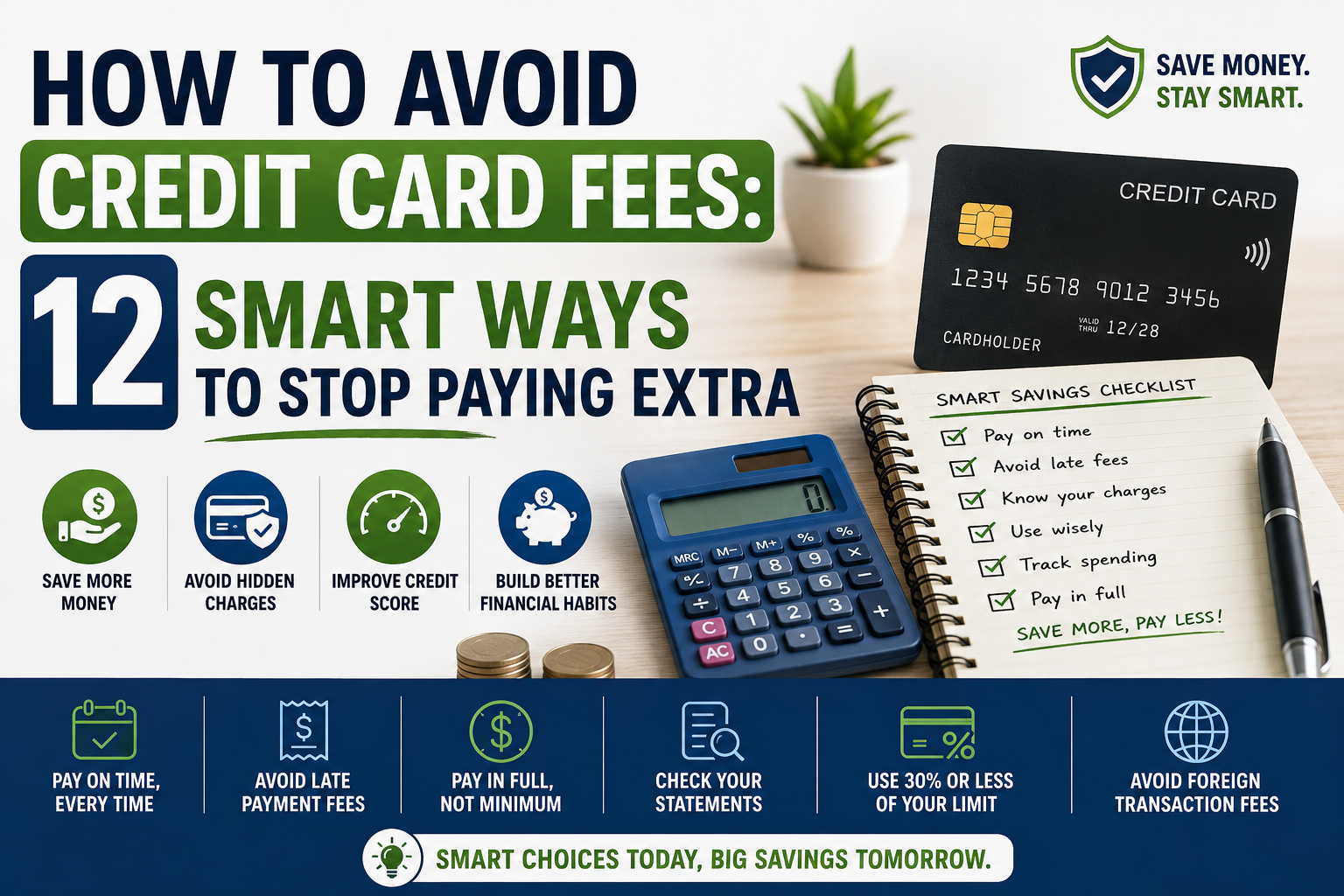
You open your credit card statement and spot a charge you did not expect. It is only $35, or $12, or maybe a few dollars of interest. It feels small, so you shrug and move on. But then it happens again the next month, and the one after that. Before long, those little charges add up to hundreds of dollars a year, and you have nothing to show for it.
Here is the good news. Most credit card fees are avoidable. You do not need to be a finance expert or earn a high income. You just need to know which fees exist, why they happen and what simple habits keep them away.
In this guide, we explain how to avoid credit card fees in clear, practical steps. You will learn about every common charge, see real examples of what they cost and pick up habits that protect your money. Whether you are new to credit cards or have used them for years, you will find something useful here.
Why Credit Card Fees Matter More Than You Think
Credit card companies earn money in several ways. Some of it comes from merchants who pay a small percentage on each purchase. A large share comes from the fees and interest that customers pay. That means the system works best for the bank when people make mistakes, such as paying late or carrying a balance.
A single fee may look harmless. But consider a person who pays one late fee of $35, carries a $1,500 balance at 24 percent APR, pays a $60 annual fee and loses $30 on a foreign transaction fee during a vacation. That adds up to about $485 in a year, even though the person feels they did nothing very wrong. Over five years, the total is close to $2,400.
Avoiding these costs is one of the easiest ways to improve your finances. It does not require earning more. It simply means keeping what you already have. Let us look at each fee and how to dodge it.
1. Late Payment Fees
A late payment fee is charged when you miss the due date on your statement. In many countries, this fee commonly falls somewhere between $25 and $40, and some issuers charge more if you are late again within a short period.
The cost goes beyond the fee itself. A late payment can trigger a penalty interest rate, which is a higher APR applied to your balance. If you are more than 30 days late, the lender may report it to the credit bureaus, and that can lower your credit score for years.
How to avoid it
- Set up automatic payments. Choose at least the minimum payment, or better, the full statement balance. This is the single most effective step.
- Use calendar or phone reminders a few days before the due date.
- Pick a due date that matches your payday. Many issuers let you change it. If your salary arrives on the 1st, a due date on the 5th is easier to hit.
- Pay early. Do not wait for the last day, since processing can take a day or two.
If you do slip once, call the issuer. Many will waive a first late fee if you have a good history and ask politely.
2. Interest Charges
Interest is the biggest cost for most cardholders. It applies when you carry a balance from one month to the next. Credit card APRs are often well above 20 percent, which makes them one of the most expensive forms of borrowing.
Here is a simple example. Suppose you owe $1,500 at 24 percent APR. That is 2 percent a month, so you pay about $30 in interest every month, or $360 a year, just to keep the debt. And if you pay only the minimum, the balance barely moves.
How to avoid it
- Pay the full statement balance every month. This is the golden rule. Most cards offer a grace period, which is the time between the end of your billing cycle and your due date. If you pay the full balance within it, you pay no interest on purchases.
- Understand the difference between the minimum payment and the statement balance. The minimum only keeps your account in good standing. It does not stop interest.
- Avoid spending more than you can repay. Treat the card like a debit card. Spend only what you already have.
- If you carry debt, tackle it quickly. Pay the card with the highest rate first while making minimum payments on the others, or consider moving the balance to a lower cost option.
Remember that the grace period usually disappears once you start carrying a balance. If you owe money from last month, new purchases may begin earning interest right away until you clear everything.
3. Annual Fees
An annual fee is a yearly charge just for having the card. Basic cards often have none, while rewards and premium cards may charge from around $50 up to several hundred dollars.
A fee is not always a bad thing. If a card gives you more in rewards, credits and perks than it costs, it can be worth it. The problem is paying for a card whose benefits you never use.
How to avoid it
- Choose no annual fee cards if you are not a heavy user of rewards.
- Do the math before you apply. Estimate yearly rewards and perks that you will actually use, then subtract the fee.
- Look for a waived first year. Use the time to decide whether the card is worth keeping.
- Ask for a downgrade. If you no longer need a premium card, ask the issuer to switch you to a no fee version. This keeps your account open and protects your credit history.
- Call before the fee posts. Sometimes the issuer will offer a retention bonus or a fee waiver to keep you as a customer.
Be careful about simply cancelling. Closing an old card can shorten your credit history and reduce your total available credit, which may affect your score.
4. Foreign Transaction Fees
A foreign transaction fee is typically about 3 percent of any purchase made in another currency or processed through a foreign bank. It also applies to some online purchases from overseas stores, even when you never leave home.
On a $1,000 spend abroad, that is $30 gone. Over a long trip, it can reach a surprising amount.
How to avoid it
- Use a card with no foreign transaction fees when you travel or shop internationally. Many travel focused cards offer this.
- Pay in the local currency. If a shop or ATM asks whether you want to be charged in your home currency, decline. The conversion rate offered at the till is usually worse.
- Check online purchases. Look at where a website is based before you buy. If it is overseas, the fee may apply.
5. Cash Advance Fees
A cash advance means using your credit card to withdraw cash from an ATM or to get cash in other ways. It is one of the most expensive things you can do with a card.
You usually pay an upfront fee, often around 3 to 5 percent of the amount. Interest also starts immediately, with no grace period, and the rate is often higher than your normal purchase rate. For example, withdrawing $500 with a 5 percent fee costs $25 right away, before any interest.
How to avoid it
- Use a debit card or your own savings for cash. Keep a small emergency fund so you never need to borrow cash on a card.
- Avoid cash like transactions. Money orders, lottery tickets, gambling chips and some money transfers may be treated as cash advances. Check your card terms.
- If you must, repay it as fast as possible. Since interest builds from day one, the quicker you pay, the less it costs.
6. Balance Transfer Fees
Balance transfers let you move debt from one card to another, often to take advantage of a low or zero percent introductory rate. They can be a great way to save on interest, but they usually carry a transfer fee of around 3 to 5 percent of the amount moved.
On a $3,000 transfer with a 4 percent fee, you pay $120 upfront. That can still be worth it if you would otherwise pay far more interest, but you need to run the numbers.
How to avoid problems
- Compare the fee with your interest savings. If the fee is lower than the interest you would pay, it may be worthwhile.
- Look for cards with no transfer fee during an introductory offer.
- Pay off the balance before the promotional period ends. After that, the rate can jump sharply.
- Do not add new spending to the card you transferred to, unless you understand how the payments are applied.
7. Over-the-Limit Fees
Some issuers charge a fee if you spend beyond your credit limit. In many places, you must agree to this in advance, so you can often decline it. Even if there is no fee, going over your limit can hurt your credit score.
How to avoid it
- Keep track of your balance. Use your bank’s app to check it regularly.
- Turn on balance and spending alerts.
- Opt out of over-limit transactions if your card gives you the choice, so purchases are simply declined rather than charged a fee.
- Ask for a limit review if you regularly get close. A higher limit can help, as long as you do not treat it as permission to spend more.
8. Returned Payment Fees
If you pay your bill and the payment bounces because your bank account lacks funds, you can face a returned payment fee from the card issuer, plus a charge from your bank. You also end up with a late payment on top.
How to avoid it
- Keep enough money in the linked account before payment dates.
- Set a low balance alert on your bank account.
- Schedule payments after payday, not before.
- Double check account details when you set up or change payment methods.
9. Replacement Card and Expedited Delivery Fees
Most issuers replace a lost or stolen card free of charge, but rushing a new card to you by express delivery can cost extra. Some also charge for rush emergency cash or for paper statements.
How to avoid it
- Ask whether there is a fee before you request express service.
- Choose standard delivery unless you really cannot wait.
- Switch to paper-free statements if there is a charge for paper copies. It is usually free, and it is better for your records too.
- Report lost cards immediately, so you are protected from fraud and can get a replacement through the normal route.
10. Hidden and Miscellaneous Fees
Besides the major charges, other smaller fees can show up on your statement. These might include fees for paying by phone with an agent, for requesting copies of old statements, or for certain account maintenance services. Some store cards and secured cards also charge setup or processing fees.
How to avoid them
- Read the terms and conditions carefully before you accept any card. Look for the fee schedule, which lists every possible charge.
- Use free payment channels, such as the online portal, the mobile app or automatic bank transfer.
- Review every statement. Look at each line, not just the total.
- Question anything you do not recognize. Contact the issuer right away. Billing errors and unauthorized charges can often be disputed.
11. Credit Utilization and Its Hidden Cost
This is not a fee on your statement, but it is a hidden cost that many people overlook. Credit utilization is the share of your available credit that you are using. If you regularly use a large part of your limit, your credit score can suffer, and a lower score can lead to higher interest rates on future loans.
How to avoid it
- Aim to keep your balance below about 30 percent of your limit, and lower is better.
- Pay down your balance before the statement closes, since that is often when your balance is reported.
- Do not close old accounts just to tidy things up, since doing so reduces your total available credit.
Protecting your score is a way of avoiding fees you have not been charged yet.
12. Build a Simple System to Keep Fees Away
Knowing about fees is one thing. Staying free of them requires a system. Here is a simple routine that works for most people.
- Automate the full payment. Set up autopay for the entire statement balance, with a backup of the minimum.
- Turn on alerts. Set up notifications for due dates, large transactions, low balances and approaching limits.
- Check your statement monthly. Spend five minutes looking for errors or surprise charges.
- Review your cards yearly. Ask whether each card still earns its place. Cancel or downgrade the ones that do not.
- Keep an emergency fund. Even a small cushion means you can avoid cash advances and credit card debt when something goes wrong.
Think of it as setting up a safety net once, so you do not have to worry about it every month.
A Quick Summary Table
| Fee | Typical cost | Best way to avoid it |
|---|---|---|
| Late payment | $25 to $40 | Autopay and reminders |
| Interest | Often 20 percent APR or more | Pay the full balance each month |
| Annual fee | $0 to several hundred dollars | Pick a no fee card or ensure value |
| Foreign transaction | About 3 percent | Use a no foreign fee card |
| Cash advance | 3 to 5 percent plus instant interest | Use debit or savings instead |
| Balance transfer | 3 to 5 percent | Compare against interest savings |
| Over limit | Varies | Opt out and set alerts |
| Returned payment | Varies | Keep enough funds in your account |
These amounts are typical examples. Check your own card’s terms for exact figures.
Common Mistakes That Lead to Extra Fees
Even careful people slip up. One common mistake is paying only the minimum, which feels safe but keeps you paying interest for years. Another is forgetting about a card you rarely use, so an annual fee quietly appears.
Many people also ignore the fine print when a card arrives, then discover fees later. Others assume that a payment made on the due date will always count, even though it may take time to process. Some use their card abroad without checking the foreign transaction fee, and some take cash from an ATM in an emergency without realizing how costly it is.
The fix is awareness. A few minutes of reading and a few simple settings can prevent most of these mistakes.
What to Do If You Already Have Fees on Your Account
If a fee has already appeared, do not panic. Start by checking whether it is correct. Compare it with your card agreement, and look at whether the charge makes sense.
Then call your card issuer. Be polite and clear. Explain what happened, mention your payment history and ask if they can remove or refund the fee as a courtesy. Many issuers will do this once, especially for a long-standing customer. If you are told no, ask whether there is another way to adjust the account, such as a lower interest rate or a payment arrangement.
If you are struggling with debt, contact the issuer early. Some offer hardship programs or reduced payment plans. A qualified financial adviser or a nonprofit credit counseling service can also help you build a plan.
Conclusion
Learning how to avoid credit card fees is one of the simplest ways to protect your money. Most charges come from a small set of causes: paying late, carrying a balance, using the wrong card abroad, taking cash advances and holding cards with fees you do not need. Each one has an easy fix.
Pay your full balance on time, ideally with autopay. Choose cards that suit how you spend and travel. Read the fee schedule before you agree to any card. Set up alerts, check your statement each month and review your cards once a year. Do those few things, and your card will work for you instead of the bank.
Start today. Open your latest statement, look at every line and note any fee you see. Then pick one habit from this guide, such as turning on autopay, and set it up before the day ends. If this guide helped, share it with a friend or family member who could use a little help keeping more of their money.