
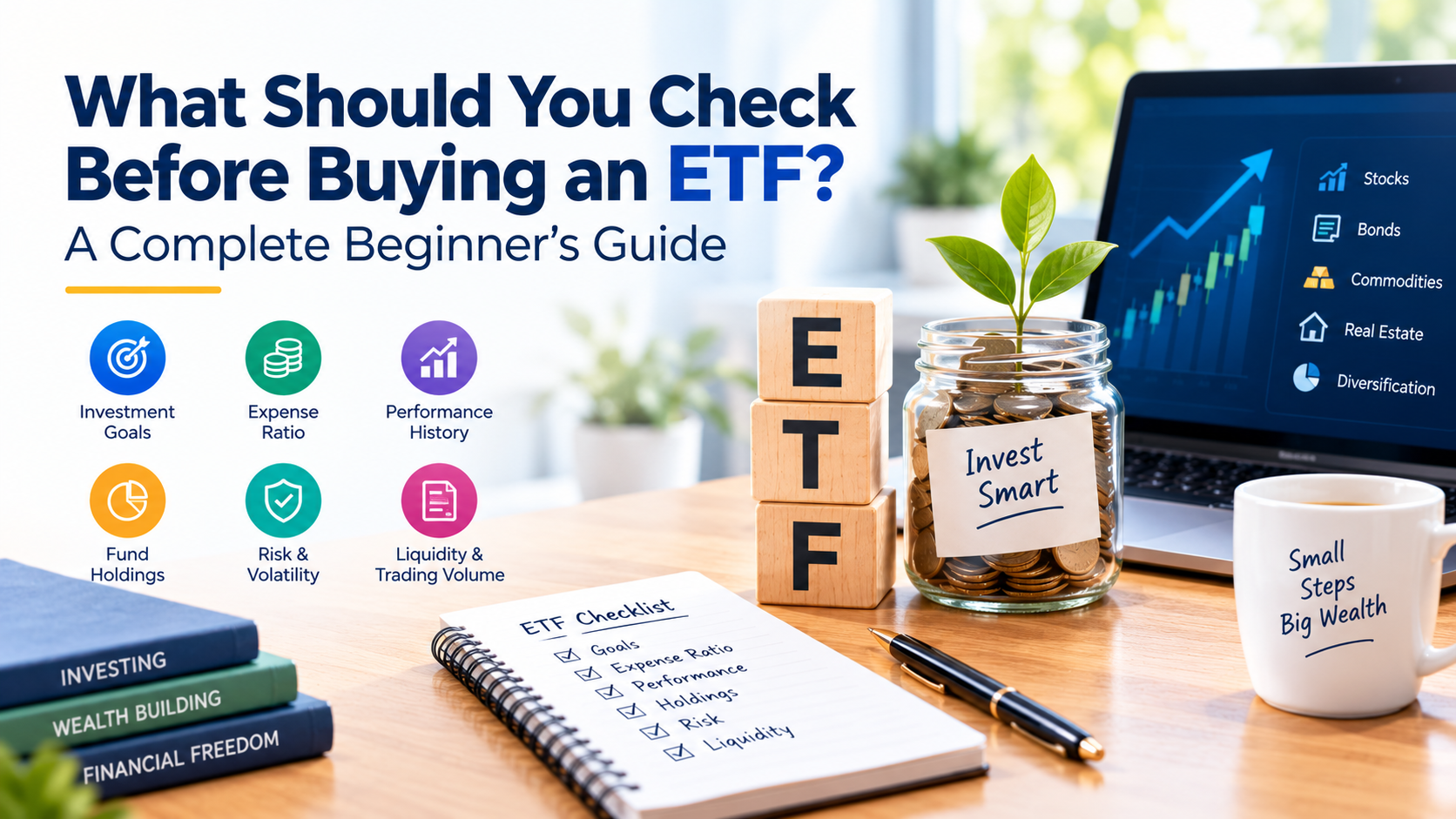
Exchange-traded funds, commonly called ETFs, have become a popular way to invest in a diversified group of assets through a single investment. Instead of purchasing individual stocks or bonds one at a time, an ETF can provide exposure to dozens, hundreds, or even thousands of securities.
This simplicity makes ETFs attractive to beginners. However, buying an ETF should not be an automatic decision. There are thousands of ETFs available, and they can have very different objectives, costs, risks, holdings, and investment strategies.
Two ETFs may appear similar at first glance but behave very differently over time. One may track a broad market index, while another may focus on a specific industry. One may have low fees and high liquidity, while another may have higher costs and limited trading activity.
Before buying an ETF, it is important to understand what you are purchasing and how it fits into your overall investment strategy. In this guide, we will explain the most important things to check before buying an ETF, especially if you are a beginner.
1. Understand What the ETF Actually Invests In
The first thing to check before buying an ETF is what it actually owns.
An ETF can hold stocks, bonds, commodities, currencies, real estate securities, or other investments. Some funds provide broad diversification, while others focus on a particular sector, country, theme, or investment style.
Do not rely only on the ETF’s name. Read the fund’s description and review its holdings.
For example, an ETF with “technology” in its name may have significant exposure to a relatively small group of technology companies. A broad-market ETF, on the other hand, may hold companies from many different industries.
Knowing what is inside the fund helps you understand the risks you are taking.
2. Check Which Index the ETF Tracks
Many ETFs are designed to track a specific index.
The index determines which securities the fund owns and how those securities are weighted. Therefore, understanding the underlying index is important before investing.
For example, two ETFs may both invest in large companies but track different indexes. Their holdings, sector exposure, weighting methods, and performance can therefore differ.
Read the ETF’s official information to find out which index it tracks and how that index is constructed.
You should also understand whether the index uses market capitalization weighting, equal weighting, or another methodology.
3. Look at the ETF’s Holdings
Reviewing the ETF’s holdings gives you a clearer picture of what you are actually buying.
Look at the largest holdings and consider how much of the portfolio they represent. If a small number of companies make up a large percentage of the ETF, the fund may be more concentrated than you initially expected.
For example, an ETF might contain 100 companies but have 40% of its assets invested in its top ten holdings. This means the performance of those companies can have a substantial impact on the fund.
The number of holdings alone does not tell you how diversified an ETF is. The weighting of those holdings also matters.
4. Check the Expense Ratio
The expense ratio is one of the most important costs to consider when buying an ETF.
It represents the annual operating expenses charged by the fund and is expressed as a percentage of the fund’s assets.
For example, suppose two ETFs follow similar investment strategies. One has a lower expense ratio while the other charges significantly more. If the funds are otherwise comparable, the lower-cost option may have an advantage for a long-term investor.
However, you should not choose an ETF based solely on its expense ratio. Tracking quality, liquidity, holdings, fund structure, and other factors also matter.
The key is to understand what you are paying and what you receive in return.
5. Examine the ETF’s Historical Performance
Historical performance can provide useful information, but it should not be the main reason for buying an ETF.
Look at how the ETF has performed over different periods rather than focusing only on its most recent return.
For example, an ETF may have performed exceptionally well during the previous year because the sector it tracks was popular. That does not mean the same performance will continue.
Compare performance with the ETF’s underlying benchmark where appropriate. This can help you understand how effectively the fund has followed its intended strategy.
Remember that historical performance does not guarantee future results.
6. Check Tracking Difference and Tracking Error
For index-tracking ETFs, it is useful to understand how closely the fund follows its benchmark.
An ETF may not perfectly match the performance of its index because of expenses, taxes, trading costs, cash holdings, portfolio management, and other factors.
Tracking difference refers to the difference between the ETF’s performance and that of its benchmark over a period.
Tracking error refers more broadly to the consistency of that difference over time.
A fund that consistently tracks its index closely may be more attractive than one that regularly deviates significantly from its benchmark, assuming other factors are similar.
7. Review the ETF’s Liquidity
Liquidity refers to how easily an ETF can be bought or sold in the market.
Highly liquid ETFs generally have more trading activity. This can make it easier for investors to enter or exit positions and may result in narrower bid-ask spreads.
The bid-ask spread is the difference between the price buyers are willing to pay and the price sellers are willing to accept.
A narrow spread can reduce the implicit cost of trading.
When considering a less popular or specialized ETF, pay particular attention to trading volume and the bid-ask spread.
8. Check the Assets Under Management
Assets under management, often abbreviated as AUM, represent the amount of money invested in the fund.
A larger ETF may have greater trading activity and a longer operating history, although size alone does not determine whether an ETF is suitable.
A very small ETF may face challenges related to liquidity or even closure if it fails to attract enough assets.
This does not mean small ETFs should automatically be avoided. Instead, consider fund size alongside liquidity, trading activity, strategy, costs, and the reputation of the fund provider.
9. Understand the ETF’s Risk Level
Every ETF has risks.
A broad stock-market ETF can decline during a market downturn. A bond ETF can be affected by interest rates and credit conditions. A sector ETF can be heavily affected by problems within a particular industry.
Some specialized ETFs can carry significantly greater volatility than broad-market funds.
Before buying, identify the major risks associated with the ETF.
Ask yourself whether you would be comfortable holding the investment if its value declined substantially during a market downturn.
If the answer is no, the ETF may not match your risk tolerance.
10. Check for Sector Concentration
An ETF may appear diversified because it holds many companies, but it could still be heavily concentrated in a particular sector.
For example, an ETF might own companies from multiple industries but have a large portion of its assets in technology.
Sector concentration can increase risk because problems affecting that industry may have a significant impact on the ETF.
Review the sector allocation before investing, especially if you already own other ETFs.
11. Check for Geographic Exposure
Where an ETF invests is another important factor.
Some ETFs focus entirely on one country. Others invest across multiple countries or regions.
International ETFs can provide geographic diversification, but they can also introduce risks related to currency movements, political developments, economic conditions, and different regulations.
If you already have significant investments in your home country, an international ETF may provide additional diversification. However, the right allocation depends on your personal investment strategy.
12. Look for Overlap With Your Existing Investments
Before buying a new ETF, compare it with the investments you already own.
Two ETFs can have different names but hold many of the same companies.
For example, an investor might own a broad-market ETF and then purchase a large-cap ETF. If the largest companies appear heavily in both funds, the new ETF may not provide much additional diversification.
Checking the top holdings of your ETFs can help identify this overlap.
A smaller number of complementary funds may be more useful than a large collection of similar ETFs.
13. Understand the Fund’s Investment Strategy
Not every ETF is designed to simply track a broad index.
Some ETFs use active management. Others focus on dividend-paying companies, value stocks, growth stocks, small-cap companies, specific sectors, or particular themes.
There are also leveraged and inverse ETFs that are designed for specific trading objectives and can carry substantially different risks.
Before buying, make sure you understand how the ETF attempts to generate returns.
Do not purchase a complex ETF simply because its recent performance looks attractive.
14. Check the Fund’s Structure
ETF structure can affect how the fund operates and how it handles its underlying investments.
Depending on the market and fund, ETFs can use different structures and methods to achieve their investment objectives.
Investors should review the official fund documentation to understand whether the ETF physically holds its underlying securities or uses other methods such as derivatives or swaps.
This is especially important when investing in specialized or complex ETFs.
15. Review the Dividend or Distribution Policy
Some ETFs distribute income generated by their underlying investments.
If an ETF invests in dividend-paying stocks or bonds, it may make periodic distributions to investors.
Before buying, understand whether the ETF distributes income, how frequently it does so, and whether the distribution policy fits your investment goals.
Do not choose an ETF simply because it has a high recent distribution yield. A high yield can sometimes be associated with additional risks.
Consider the underlying investments and overall total return rather than focusing only on distributions.
16. Check the ETF’s Tax Considerations
Taxes can affect the return you actually receive from an investment.
The tax treatment of ETF dividends, distributions, and capital gains depends on the country where you live and your individual circumstances.
Some ETFs may also have tax implications related to foreign investments or cross-border holdings.
Before investing, understand the applicable tax rules. If the situation is complicated, consider consulting a qualified tax professional.
Looking at investment returns without considering taxes can give you an incomplete picture.
17. Check the Fund Provider
The company managing or sponsoring the ETF is also worth considering.
Look at the fund provider’s reputation, experience, range of investment products, transparency, and the information it provides to investors.
A well-established provider may offer extensive fund documentation and investor resources.
However, a large provider does not automatically make every ETF it offers suitable for you. The specific fund still needs to fit your investment goals and strategy.
18. Understand the ETF’s Trading Price
ETF shares trade throughout the market day, so their trading price can move above or below the value of the underlying assets.
This is known as trading at a premium or discount to net asset value, or NAV.
For highly liquid ETFs, these differences are often relatively small. Less liquid or specialized funds can sometimes experience larger differences.
Understanding NAV and market price can help you better understand how ETF trading works.
19. Consider Your Investment Time Horizon
Your investment time horizon is the length of time you expect to keep your money invested.
An ETF that may be suitable for a long-term investor may not be appropriate for someone who needs the money soon.
For example, a stock-focused ETF can experience significant short-term fluctuations. If you need the money within a few months, you may not have enough time to recover from a market decline.
Before buying an ETF, consider when you expect to need the money and whether you can tolerate temporary losses.
20. Make Sure the ETF Has a Clear Purpose in Your Portfolio
Every investment should have a reason for being in your portfolio.
Before buying an ETF, ask yourself what role it will play.
Is it providing broad stock exposure? International diversification? Bond exposure? Sector exposure? Income? Another specific investment objective?
If you cannot explain why you need the ETF, it may be better to research the investment further before buying.
A clear purpose can prevent your portfolio from becoming unnecessarily complicated.
A Simple Example of Evaluating an ETF
Imagine that Amit finds an ETF that has delivered strong returns over the last three years.
Instead of immediately investing, he checks the fund’s holdings. He discovers that a small number of companies make up a large percentage of the portfolio.
He then checks the expense ratio and compares it with similar ETFs. He also reviews the fund’s benchmark, trading volume, bid-ask spread, sector allocation, and geographic exposure.
Finally, Amit compares the ETF with the investments he already owns. He realizes that several of its largest holdings are already present in his portfolio.
This research helps him understand that the ETF may not provide as much additional diversification as he initially thought.
The example demonstrates why looking beyond recent performance is important when evaluating an ETF.
A Pre-Purchase ETF Checklist
Before buying an ETF, take a few minutes to review the following:
What does it hold?
Understand the underlying securities and major holdings.
What does it track?
Identify the index or investment strategy.
How much does it cost?
Check the expense ratio and other potential costs.
How diversified is it?
Review company, sector, and geographic concentration.
How liquid is it?
Look at trading volume and bid-ask spreads.
How closely does it track its benchmark?
Review tracking difference and tracking error where relevant.
Does it overlap with my portfolio?
Compare its major holdings with your existing investments.
What risks does it carry?
Understand the factors that could cause the ETF to lose value.
Does it match my goals?
Consider your investment horizon, risk tolerance, and financial objectives.
What are the tax implications?
Understand how distributions and gains may be taxed in your situation.
Final Thoughts
Choosing an ETF should involve more than looking at its recent return or searching for the fund with the lowest price. A good investment decision starts with understanding what the ETF owns, how it works, what it costs, and how it fits into your overall portfolio.
Check the ETF’s holdings, benchmark, expense ratio, liquidity, risk level, sector and geographic exposure, tracking performance, and potential overlap with your existing investments. Also consider your investment time horizon and the tax rules that apply to you.
The goal is not to find the ETF that looks most exciting. It is to find an investment that makes sense for your financial strategy and that you can comfortably hold through different market conditions.
Taking a little extra time to research an ETF before buying can help you make more informed investment decisions and avoid many common ETF investing mistakes.