
Most people spend hours choosing their first investments and then never look at them again. Others go to the opposite extreme and check their balance every morning, feeling thrilled one day and sick the next. Neither habit helps you build wealth.
A smart portfolio review sits in the middle. It is a calm, scheduled check-in where you ask whether your investments still match your life. In this guide, you will learn how to review your investment portfolio, what to look at, how often to do it, and which mistakes to avoid. You do not need a finance degree. You just need an hour and a clear process.
Why You Should Review Your Portfolio Regularly
Your life changes over time, and your investments should keep up. You may get a raise, change careers, buy a home, or start a family. Each of these shifts your goals and your tolerance for risk. A portfolio that made sense three years ago may no longer fit.
Markets change things too. A strong year for stocks can quietly push your portfolio into a riskier mix than you planned. Fees can creep up. A fund that once performed well may start lagging its peers. Without a regular review, these small problems grow unnoticed.
A review is not about reacting to headlines. It is about making sure your plan still works. Think of it like a yearly health checkup for your money.
How Often Should You Review Your Portfolio?
For most long-term investors, once or twice a year is enough. Pick a date you will remember, such as your birthday or the start of a new year. Checking more often than every quarter usually leads to emotional decisions, since short-term price swings are mostly noise.
There are also moments that call for an extra review, no matter the calendar:
- A major life event like marriage, a new baby, or a job change
- A big change in income or expenses
- A major shift in your goals or timeline
- A large windfall, such as an inheritance or bonus
Outside of these, resist the urge to tinker. Frequent changes often cost more in fees and taxes than they ever earn.
Step 1: Revisit Your Goals and Time Horizon
Start with the “why.” Write down what each investment is for, and when you will need the money. Retirement in 25 years, a house deposit in four years, and a child’s education in twelve years all call for different strategies.
Ask yourself whether anything has changed. Maybe you now want to retire earlier, or maybe a home purchase got pushed back. If your goals have shifted, your portfolio may need to shift as well. A goal that is getting close needs safer investments, while a distant goal can stay more growth focused.
Step 2: Gather Everything in One Place
Many people have money scattered across several accounts: a workplace retirement plan, a brokerage app, an old account from a previous job, and maybe some savings. It is hard to judge a portfolio you cannot see in full.
Make a simple list or spreadsheet showing every account, what it holds, and its current value. Include retirement accounts, taxable accounts, and any cash set aside for investing. Seeing the whole picture often reveals surprises, like owning the same stock through three different funds.
Step 3: Check Your Asset Allocation
Asset allocation is how your money is split between stocks, bonds, cash, and other assets. It is the biggest driver of how your portfolio behaves, so it deserves the most attention.
Compare your current split with your target. Say you planned for 70% stocks and 30% bonds. After a strong market run, you might find yourself at 82% stocks. That means you are taking more risk than you intended, even though you never made a single new decision.
Match Your Allocation to Your Stage of Life
A common rule of thumb is that younger investors can hold more stocks because they have time to recover from downturns. People closer to needing the money usually hold more bonds and cash. There is no perfect formula, so choose a mix you can stick with when markets get rough.
Step 4: Measure Your Performance the Right Way
Looking at returns is helpful, but only if you do it properly. A fund that gained 8% sounds fine until you learn that its benchmark rose 12%.
Compare Against a Fair Benchmark
Every investment should be compared with something similar. A US large company fund should be measured against an index like the S&P 500. A global fund should be compared with a global index. If your fund trails its benchmark by a wide margin year after year, it is worth asking why.
Look at the Long View
Judge performance over three, five, and ten years where possible. One bad year does not make a bad investment, and one great year does not make a great one. Avoid dumping something just because it had a rough twelve months.
Check Your Personal Rate of Return
Your own return depends on when you added money, not only on what the fund did. Many brokers show a personal return figure that accounts for your deposits and withdrawals. This gives a more honest view of how you are really doing.
Step 5: Look at Fees and Costs
Fees are one of the few things you can control, and they quietly eat into returns every year. Look at the expense ratio of each fund, any trading commissions, and account maintenance charges.
A fund charging 1% a year versus one charging 0.1% may sound like a small gap. Over 30 years on a growing portfolio, it can cost tens of thousands of dollars. If you find a similar fund with much lower costs, switching may be worth it, as long as you consider any tax impact first.
Step 6: Check Diversification and Overlap
Diversification protects you when one part of the market struggles. During your review, ask whether your money is spread across different industries, company sizes, and regions.
Watch for hidden overlap. Owning three different funds that all hold the same big technology companies is not true diversification. Many fund providers offer free tools that show what is inside your funds. Use them to make sure you are not accidentally concentrated in one area.
Also check how much you hold in any single stock, especially your employer’s. If your paycheck and your portfolio both depend on one company, a bad turn could hurt twice.
Step 7: Rebalance If Needed
Rebalancing means bringing your portfolio back to your target mix. If stocks have grown larger than planned, you sell a bit of them and buy more bonds, or you direct new contributions toward the underweight areas.
Simple Ways to Rebalance
- Use new money. Put fresh contributions into whatever is below target. This avoids selling and keeps taxes low.
- Use a threshold. Rebalance only when an asset drifts more than 5 percentage points from its target.
- Use the calendar. Rebalance once a year during your regular review.
Be mindful of taxes. Selling investments in a taxable account can create a tax bill, so rebalancing inside retirement accounts is often easier. Rules differ by country, so check what applies to you.
Step 8: Review Your Contributions
Ask whether you are saving enough. If your income has grown, can you raise your monthly contribution? Even a small increase, like going from 8% to 10% of your income, can make a big difference over decades.
Also confirm that automatic investments are still running. Cards expire, accounts change, and transfers sometimes fail without anyone noticing. If your employer offers a retirement match, make sure you are contributing enough to get the full amount. That match is free money.
Step 9: Update Your Paperwork
This step feels dull but matters a lot. Check that your beneficiaries are current on every account. Life events like marriage or divorce can make old designations wrong. Also confirm your contact details are accurate, and keep a record of where all your accounts are held so your family could find them if needed.
A Real-Life Example
Take Sarah, a 34-year-old designer who started investing at 27. She planned for 80% stocks and 20% bonds. When she did her annual review, she noticed her mix had drifted to 90% stocks after a long bull market. She also saw that one of her funds charged a 1.2% fee, while a near-identical index fund charged 0.1%.
Sarah rebalanced by directing her next several contributions into bonds, and she switched to the cheaper fund inside her retirement account, where it caused no tax bill. The whole review took her about 90 minutes. She did not chase any hot tips or make dramatic bets. She just brought her plan back in line, and she saves roughly a thousand dollars in fees over the next few years.
Common Mistakes to Avoid
Checking Too Often
Daily or weekly checking encourages panic and overreaction. Schedule your reviews and stick to them.
Selling Winners Too Early and Holding Losers Too Long
People like locking in gains and hate admitting losses. Base your decisions on your plan and the investment’s future prospects, not on whether you are up or down right now.
Chasing Last Year’s Best Performers
A fund that topped the charts last year often does not repeat. Switching to whatever is hot usually means buying high.
Ignoring Taxes
A good move on paper can become a poor one after taxes. Think about the tax effect before you sell anything in a taxable account.
Making Big Changes After a Market Drop
Selling in fear is among the costliest mistakes. If your plan was sound before the drop, it is probably still sound afterward.
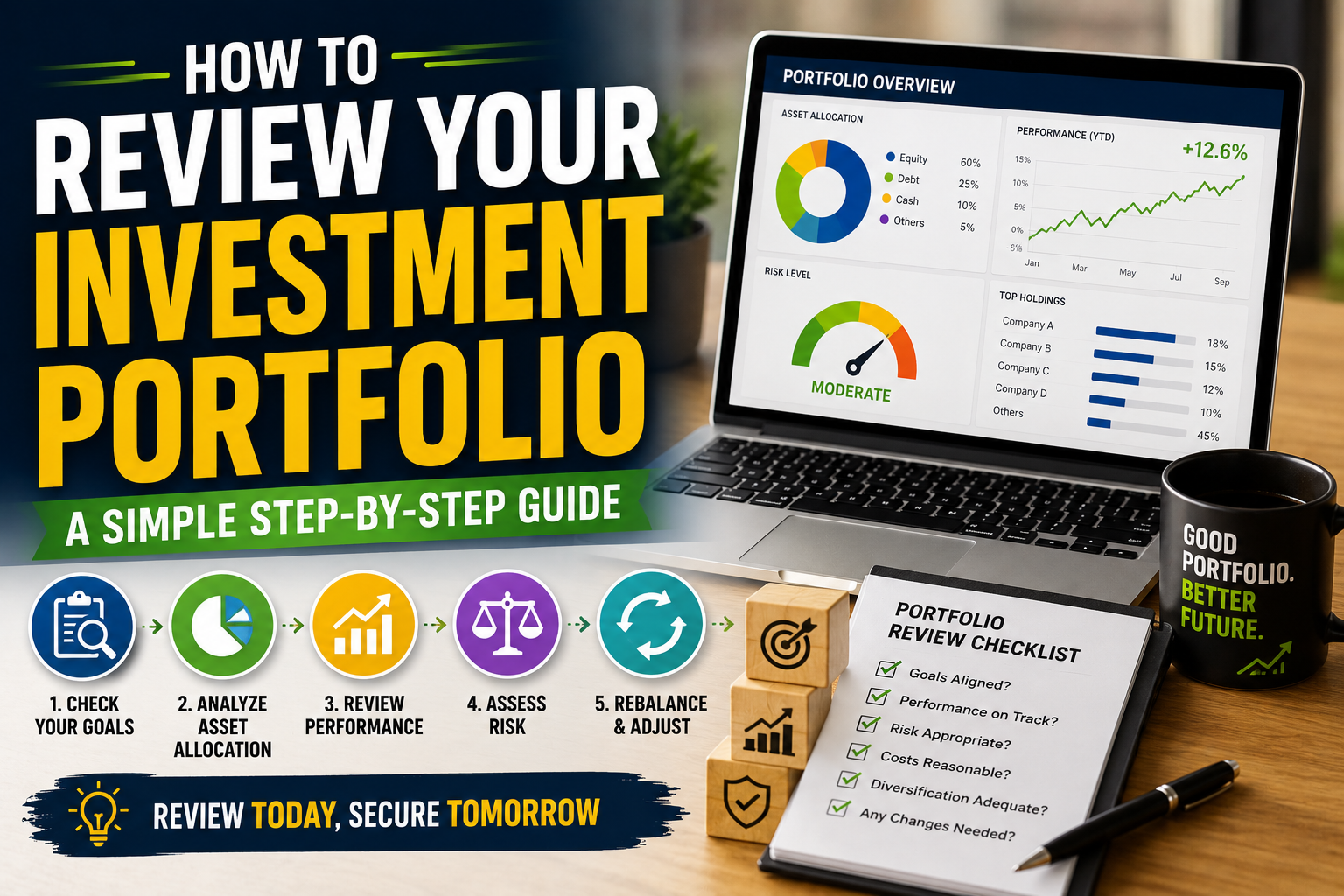
Your Quick Portfolio Review Checklist
- Have my goals or timeline changed?
- Do I know every account I own and what is inside?
- Does my asset allocation still match my target?
- How have my investments performed against fair benchmarks?
- Are my fees as low as they reasonably can be?
- Am I properly diversified, with no hidden overlap?
- Do I need to rebalance?
- Am I contributing enough, and is everything automated?
- Are my beneficiaries and details up to date?
Frequently Asked Questions
How often should I review my investment portfolio?
Once or twice a year works well for most long-term investors. Add extra reviews after big life changes.
What should I look at first in a portfolio review?
Start with your goals, then check your asset allocation. Allocation has the largest effect on risk and returns.
When should I sell an investment during a review?
Consider selling if your goals changed, the fund has consistently lagged similar options, fees are too high, or it no longer fits your plan. Do not sell just because of a short-term drop.
Do I need a financial advisor to review my portfolio?
Not always. Many people handle a simple review themselves. An advisor can help if your situation is complex, such as multiple income sources, business ownership, or large assets.
Final Thoughts
Learning how to review your investment portfolio is one of the best habits you can build. It keeps your plan aligned with your life, keeps costs low, and helps you avoid emotional mistakes. The process is not complicated. Revisit your goals, check your allocation, look at performance and fees, rebalance if needed, and make sure your paperwork is current.
Set a calendar reminder right now for your next review, then block out one hour. Bring your account list, a cup of coffee, and the checklist above. Small, regular check-ins are what keep long-term plans on track.
Disclaimer: This article is for general educational purposes only and is not personalized financial advice. Examples are illustrative and not guaranteed. All investments carry risk, including the loss of money. Tax rules vary by country, so consider speaking with a licensed financial advisor before making decisions.