
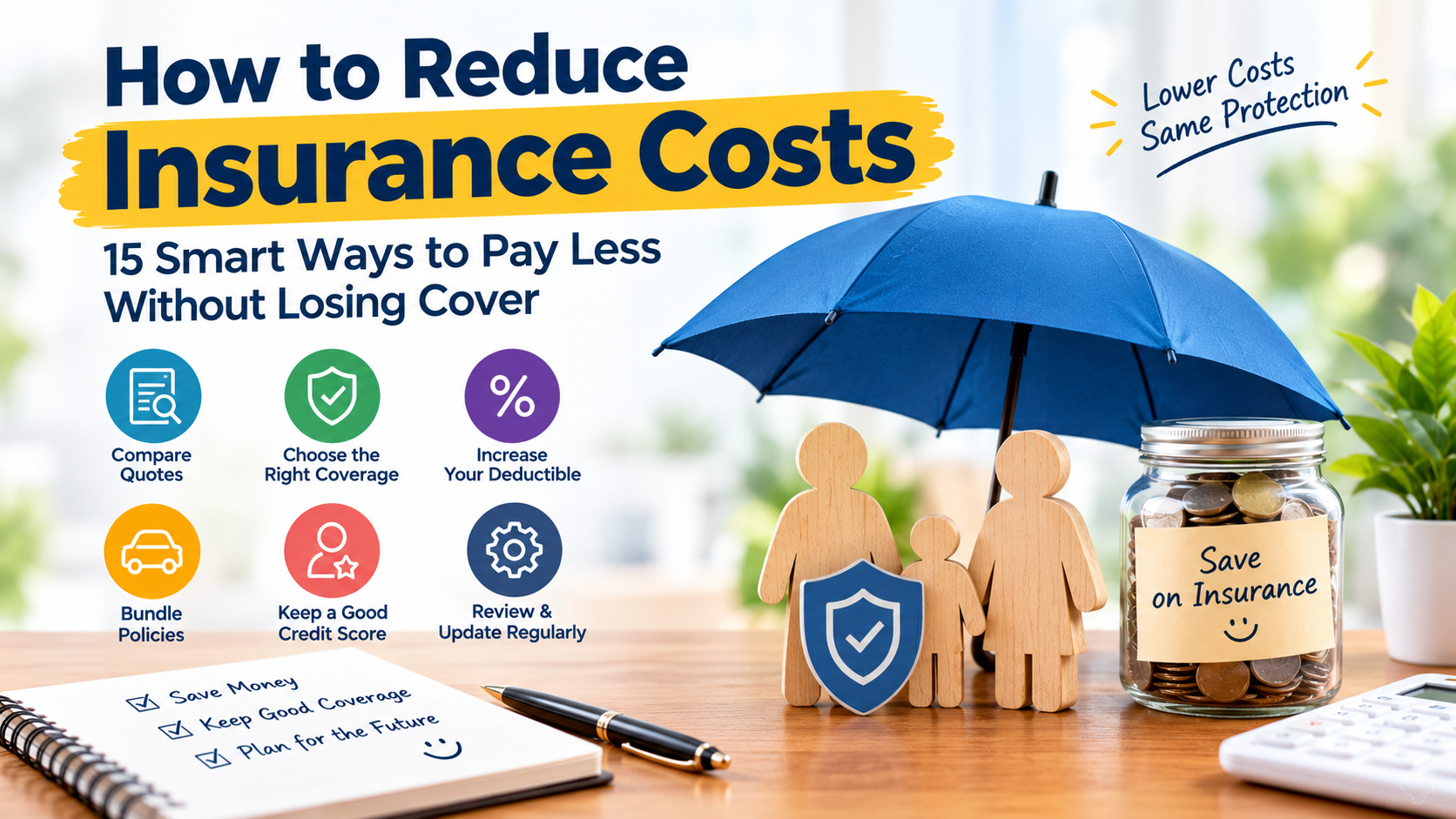
Open your bank statement at the end of the year and add up everything you pay for insurance. Life, health, car, bike, maybe travel. The total can be a shock. For many families, insurance quietly becomes one of the biggest yearly expenses, right after rent and groceries.
The tricky part is that you cannot simply stop paying. Insurance is there to protect you from financial trouble, and cutting it carelessly can create more trouble than it saves. The real goal is to pay less for the same level of protection.
The good news is that this is very possible. In this guide on how to reduce insurance costs, we will share simple, practical ways to lower your premiums without weakening your cover. These tips work for most types of insurance, and you can start using many of them today.
First, Understand What Decides Your Premium
To lower a cost, it helps to know where it comes from. Insurers calculate premiums based on risk. The higher the chance of a claim, the higher the price.
Common factors include:
- Your age: Younger people usually pay less for life and health cover.
- Your health and habits: Smoking, heavy drinking and certain medical conditions can raise premiums.
- The cover amount: A higher sum insured means a higher premium.
- The policy term: Longer terms can cost more in total.
- Your location and lifestyle: City, occupation and activities matter.
- Your claim history: A record of frequent claims may increase your cost.
- For vehicles: The make, model, age and engine size matter a lot.
Some of these you cannot change. But many you can influence, and that is where your savings are hiding.
1. Compare Quotes Before You Buy or Renew
This is the easiest way to save money, and many people skip it. Two insurers can quote very different prices for almost the same cover.
Collect at least three quotes with the same sum insured, term and add-ons. Online comparison tools make this quick. But remember to compare benefits too, not just price. A cheaper plan with weak coverage is not a real saving.
Do this every year at renewal. Loyalty to one insurer does not always mean the best price.
2. Buy Life Insurance Early
Premiums rise as you age. A person who buys a term plan at 28 will usually pay much less every year than someone who buys the same cover at 40, and the premium stays fixed for the whole term.
Buying young also means you are more likely to be in good health, which helps you qualify for better rates. If you have been putting off life insurance, this is the strongest reason to act now.
3. Choose Term Insurance for Pure Protection
Traditional savings plans combine insurance and investment. They often give a small life cover for a high premium. A term plan does one thing, which is protect your family, and it does it at a much lower cost.
You can invest the money you save separately in options that suit your goals. This keeps both parts of your finances clearer and more efficient.
4. Stay Healthy and Avoid Smoking
Insurers love healthy customers. Non-smokers often pay noticeably less for life and health insurance than smokers. Maintaining a healthy weight, controlling blood pressure and keeping fit can also help at the time of buying and renewal.
Some health plans even offer wellness rewards or discounts for healthy habits, such as regular check-ups or activity goals. It is a bonus that supports your wellbeing and your wallet.
5. Pay Annually Instead of Monthly
Many insurers add a small extra charge if you pay in monthly or quarterly instalments. Paying the full year at once can lower the total cost.
If a big yearly payment is hard, set aside a small amount each month in a separate account and pay the premium when it is due. You get the discount without feeling the pinch.
6. Pick the Right Sum Insured
More cover is not always better, and less is not always cheaper in the long run.
For life insurance, calculate a realistic amount based on your income, loans and goals instead of choosing a random high figure. For health insurance, a good base cover with a top-up plan is often cheaper than a very large base plan. For vehicles, set the insured value fairly based on the current market value of your car or bike.
The idea is to cover real risks, not to overpay for protection you do not need.
7. Use a Super Top-Up for Health Insurance
If you want high health cover without a huge premium, a super top-up plan can be a clever option. You keep a base policy with a moderate cover and add a top-up with a higher cover that activates once your claims cross a certain limit, known as the deductible.
Because the top-up starts working only after that limit, its premium is much lower than that of a big regular plan. It is a popular way to build strong protection at a smaller cost.
8. Choose a Family Floater When It Fits
A family floater plan covers all family members under one sum insured. For a young family with healthy members, it is usually cheaper than buying separate plans for everyone.
But if you have senior parents, a separate policy for them is often wiser, since their higher risk can raise the premium of the whole floater.
9. Build and Protect Your No Claim Bonus
In motor insurance, the No Claim Bonus, or NCB, is a discount you earn on your own-damage premium for each claim-free year. It can grow to a significant percentage over time.
For small repairs, it may be cheaper to pay from your pocket instead of making a claim and losing the bonus. Some insurers also offer NCB protection as an add-on. Think carefully before filing minor claims.
Health plans may also give bonuses for claim-free years, usually as extra cover instead of a discount.
10. Consider a Voluntary Deductible
A deductible is the portion of a claim that you agree to pay yourself. If you choose a higher voluntary deductible in your motor or health policy, your premium usually drops.
This works well if you can comfortably afford the small out-of-pocket amount in an emergency. It is not a good idea if that amount would put you in trouble.
11. Remove Add-Ons You Do Not Need
Insurers often bundle extra covers into a policy. Some are useful, but others may not suit your situation.
Review your add-ons each year. For example, in a motor policy, a zero-depreciation cover can be very helpful for a newer car but less valuable for an old one. Do not remove something just to save a little, but do drop what you truly do not need.
12. Add Safety Features to Your Vehicle or Home
Insurers like lower risk. Approved anti-theft devices on your car may qualify you for a discount, and so can a secure building, fire safety systems or alarms for your home.
Check with your insurer which features count and what proof they need.
13. Bundle or Ask About Multi-Policy Discounts
Some companies offer discounts if you buy more than one policy from them, or if you add family members to your plan. The saving can be small or large, so always ask.
Do not bundle just for the discount, though. Make sure each policy is strong on its own.
14. Never Let a Policy Lapse
A lapsed policy can cost you more in the end. You may lose your no claim bonus, waiting period benefits or the chance to renew at your old rate. In life and health insurance, buying again later can mean higher premiums because of age or new health conditions.
Set reminders or use auto-debit so that you never miss a due date.
15. Review Your Policies Every Year
Your life changes, and so should your insurance. Maybe a loan is cleared, your children have grown up or you no longer need an old add-on. Or maybe a new, better plan has entered the market.
A yearly check can reveal duplicate cover, outdated plans or chances to switch to something cheaper. Just be careful not to cancel policies too fast. Compare, check surrender or porting rules and then decide.
A Real-Life Example: How Rakesh Saved Money
Rakesh is 34, married with one child and owns a car. Every year, he paid his premiums without thinking. Then he decided to review everything.
- Life insurance: He held an endowment plan with a small cover and a high premium. After checking the terms and getting advice, he bought a larger term plan at a much lower cost and kept the old plan for its remaining benefits.
- Health insurance: He replaced a very expensive large-cover plan with a moderate base plan and a super top-up, getting the same total protection for less.
- Motor insurance: He compared quotes, chose a voluntary deductible he was comfortable with and removed an add-on his older car did not really need.
- Payment: He moved from monthly to annual payments for his policies where the insurer offered a discount.
By the end, Rakesh had better protection and a lower yearly bill. None of the changes were complicated, and all of them came from comparing, reviewing and choosing sensibly.
Mistakes to Avoid While Cutting Costs
- Cutting cover too low. Saving a little now can hurt badly later.
- Hiding information to get a cheaper quote. This can lead to claim rejection.
- Buying a cheap policy without reading it. Check the exclusions, limits and waiting periods.
- Cancelling an old policy in a hurry. Early exit can mean lost benefits and charges.
- Ignoring the claim record of the insurer. Cheap premiums do not help if claims are hard to get.
- Over-relying on discounts. A huge discount is good only if the policy remains strong.
Frequently Asked Questions
Can I reduce my insurance premium after buying the policy? Sometimes, through options like reducing add-ons or choosing a higher deductible at renewal. Term life premiums are usually fixed once the policy starts, so the best savings come from smart choices at the time of buying.
Does a higher deductible really lower the premium? Yes, in most plans. You share a part of the claim, so the insurer takes less risk and charges less.
Is it safe to buy the cheapest insurance? Not always. Look at the cover, exclusions and claim record, and then pick the most affordable plan among good ones.
Can I negotiate insurance premiums? In most cases, rates are fixed by the insurer, and some, such as third-party motor premiums, are set by the regulator. But you can reduce your cost through comparison, discounts and policy choices.
How often should I compare insurance quotes? At least once a year at renewal, and whenever you buy a new policy.
Final Thoughts
Knowing how to reduce insurance costs is not about finding tricks. It is about making clear, thoughtful choices. Compare quotes, buy early, pick the right cover, use discounts and keep your policies in order.
Your goal is not to pay the smallest amount possible, but to pay a fair price for solid protection. Start with one or two steps from this list, such as comparing quotes at your next renewal or checking your add-ons. Small steps add up, and by the end of the year you may find that your wallet and your peace of mind are both in better shape.
Disclaimer: This article is for general information only and is not financial or insurance advice. Premiums, discounts and rules vary by insurer, so please read policy documents carefully and consult a licensed advisor before making changes.