
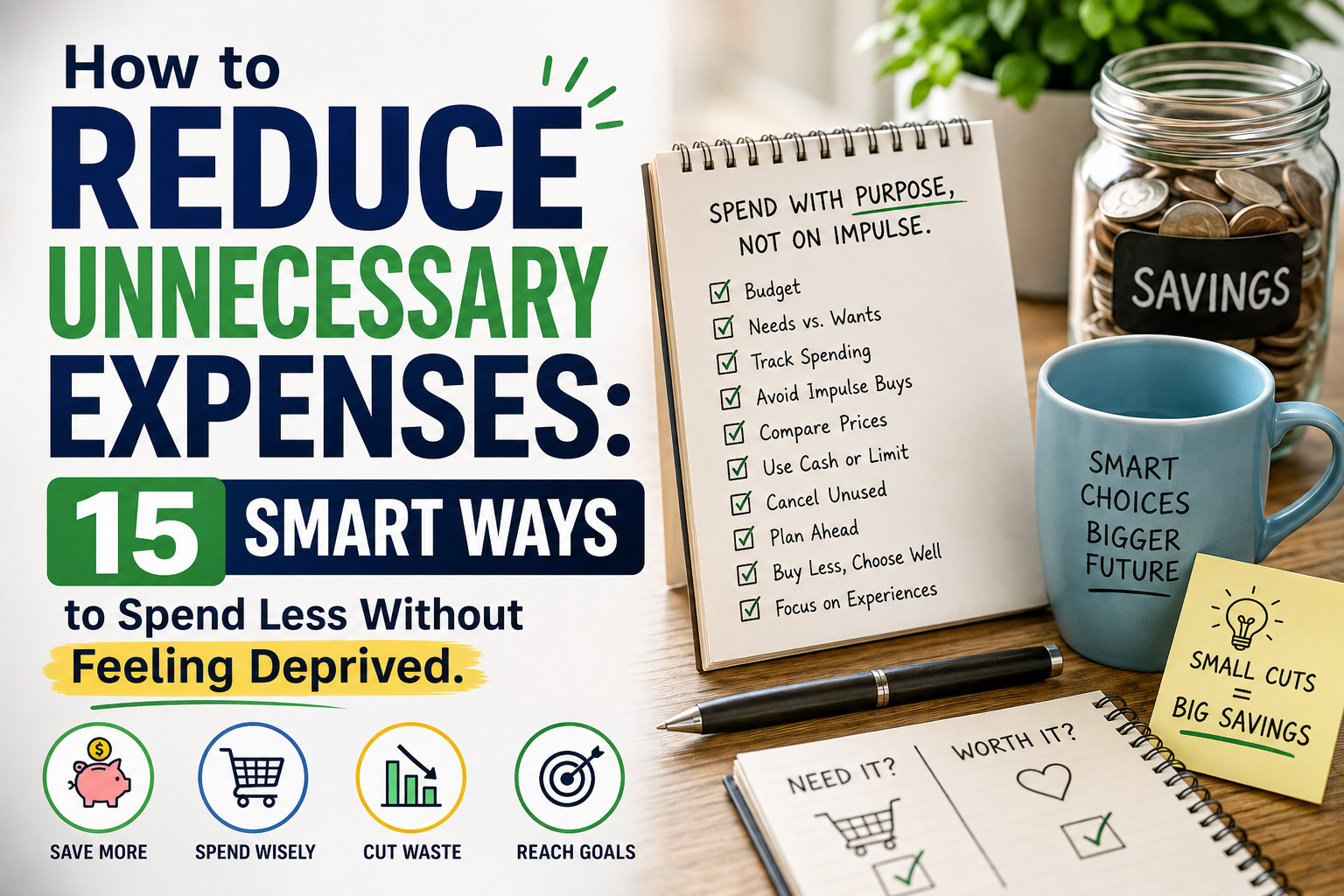
Check your bank statement from last month. Chances are you will find a few charges that make you pause. A subscription you forgot about. Three food delivery orders in one week. A gym membership you have not used since spring. None of these purchases feels big on its own, but together they quietly drain hundreds from your account every year.
The good news is that cutting unnecessary expenses does not mean living on rice and beans or giving up every joy. It means spending on what matters to you and cutting what does not. This guide shows you how to find wasteful spending, reduce it step by step, and keep the savings going month after month. The tips work whether you live in the USA, the UK or Germany.
What Counts as an Unnecessary Expense?
An unnecessary expense is money you spend without getting real value in return. It is not the same as a “want.” You can want something and still get great value from it. A weekly football match with friends or a hobby you love is money well spent. An unnecessary expense is the one you barely notice, rarely use or regret afterward.
Here is a simple test. Ask yourself, “If I stopped paying for this tomorrow, would I actually miss it?” If the honest answer is no, you have found a candidate to cut.
Most unnecessary spending falls into a few groups:
- Forgotten or unused subscriptions and memberships
- Impulse purchases and “just browsing” shopping
- Food waste and too much eating out
- Overpaying for bills like energy, phone and insurance
- Bank fees, late fees and interest charges
- Lifestyle creep, where spending rises along with income
Once you know the categories, it becomes much easier to spot the leaks.
Step 1: Find Out Where Your Money Actually Goes
You cannot fix what you cannot see. Before you cut anything, you need a clear picture of your spending. Most people are surprised by what they find.
Download your bank and credit card statements for the last three months. Go through them line by line and mark every purchase as a need, a want you truly enjoy, or something you barely notice. Use a highlighter, a spreadsheet or a budgeting app, whichever feels easiest.
When you finish, add up the third group. This number is your savings opportunity. Many people discover that they can free up 5% to 15% of their income just by trimming this category. If you have never tracked your spending before, a monthly plan such as a zero-based budget can make this process even easier.
Step 2: Cancel Subscriptions You Do Not Use
Subscriptions are one of the sneakiest budget drains. They are designed to be easy to start and easy to forget. Streaming platforms, music apps, cloud storage, meal kits, gym memberships, magazine services and free trials that turned into paid plans all pile up.
Here is how to clean them out:
- Search your statements for recurring payments
- Write down every subscription and its cost
- Cancel anything you have not used in the last 30 days
- Downgrade plans you only partly use, such as a premium tier when the basic one is enough
- Rotate streaming services instead of paying for all of them at once
For example, if you pay for four streaming services at $15 each, that is $720 a year. Keeping one or two and rotating the others can easily cut that in half.
Note for readers in the UK and Germany: Both countries have consumer protection rules that make cancelling easier in many cases. In Germany, for example, a “Kündigungsbutton” is now required on many websites that offer online contracts. Check the current rules and your contract terms before cancelling.
Step 3: Cut Down on Food Waste and Eating Out
Food is one of the biggest flexible spending categories, and it is full of hidden waste. Studies in the USA, UK and Germany regularly find that households throw away a significant share of the food they buy. That is money going straight into the bin.
A few simple habits can change this:
Plan your meals for the week. Write down what you will cook before you go shopping. A plan stops you from buying random items that spoil before you use them.
Shop with a list. Stick to it. Impulse buys at the supermarket add up quickly, especially near the checkout.
Use leftovers on purpose. Roast chicken on Sunday becomes sandwiches on Monday and soup on Tuesday. Freeze what you cannot eat in time.
Limit delivery apps. Delivery fees, service charges and tips can add 30% or more to the price of a meal. Picking up your own food or cooking at home cuts that cost immediately.
Try a “restaurant budget.” Instead of banning eating out, set a monthly amount for it. When it runs out, you cook at home. This keeps your social life alive without wrecking your finances.
Step 4: Lower Your Regular Bills
Many households overpay for services simply because they stopped checking prices. Bills are some of the easiest places to save because you only need to act once to enjoy the savings every month.
Energy and Utilities
Compare energy suppliers if your country allows you to switch. In the UK and Germany, comparison sites can help you find cheaper tariffs. In the USA, options depend on your state, but you can still lower costs by using a smart thermostat, sealing drafts and switching to LED bulbs.
Small habits help too. Turn off devices on standby, wash clothes at 30°C or 86°F when possible, and avoid heating rooms you are not using. These changes will not make you rich overnight, but over a year they can save a meaningful amount.
Phone and Internet
Call your provider and ask about current deals for existing customers. If they refuse, look at what new customers are offered elsewhere. Many people save $20, £15 or €15 a month by switching to a cheaper plan or a SIM-only deal. Check the contract end date first to avoid exit fees.
Insurance
Compare quotes for car, home and contents insurance every year. Loyalty rarely pays here. Insurers often reserve their best prices for new customers. Raising your deductible or excess can lower your premium too, but only do this if you have enough savings to cover it.
Step 5: Avoid Impulse Buying
Impulse spending is one of the biggest causes of regret and wasted money. Online shopping makes it even easier, with one-click payments, flash sales and endless targeted ads.
Try these simple tricks:
- Use the 48-hour rule. Put non-essential items in your cart and wait two days. If you still want it, buy it. Most of the time the urge fades.
- Unsubscribe from marketing emails. Fewer promotions mean fewer temptations.
- Remove saved card details. A few extra seconds at checkout can give you time to think.
- Delete shopping apps from your phone if you tend to browse when bored.
- Calculate the cost in work hours. If you earn $20 an hour, a $100 jacket costs five hours of your life. Is it worth it?
Impulse buying is not a character flaw. It is a normal response to clever marketing. The solution is to add a little friction between the urge and the purchase.
Step 6: Stop Paying Fees and Interest You Can Avoid
Some of the most unnecessary expenses are the ones that bring you nothing at all. Bank fees, overdraft charges, late payment penalties and credit card interest are all examples.
Set up automatic payments for at least the minimum on every bill so you never miss a due date. Choose a bank account without monthly fees if possible. In the UK and Germany, many banks offer free current accounts. In the USA, look for accounts with no monthly maintenance fee and free access to a large ATM network.
If you carry credit card debt, make it a priority. Interest rates on credit cards are often 20% or higher, which is a huge unnecessary cost. Paying down this debt quickly does more for your finances than almost any other trick. Consider a balance transfer or a lower interest loan if you qualify, but read the fine print on fees first.
Step 7: Beware of Lifestyle Creep
Lifestyle creep happens when your spending slowly rises as your income grows. You get a raise, and suddenly you upgrade your phone, move to a pricier flat and start buying more expensive coffee. Each change feels small and reasonable, yet your savings stay exactly where they were.
To fight it, decide ahead of time what you will do with extra income. A simple approach is to split any raise: put half toward savings or debt payoff and use the other half to enjoy life a little more. That way you still reward yourself, but your future benefits too.
Step 8: Buy Smarter, Not Just Less
Cutting expenses does not always mean buying nothing. Sometimes it means buying better.
Buy second-hand when it makes sense. Furniture, books, tools, baby gear and even clothing are often available in great condition at a fraction of the price. Platforms like eBay, Vinted, Facebook Marketplace and local charity shops are good places to start.
Choose quality for items you use daily. A pair of sturdy boots that lasts five years can cost less per year than cheap ones you replace every few months.
Use cashback and loyalty programs wisely. They are helpful only if they do not push you to spend more than you planned.
Compare prices before buying. A quick search can reveal big differences between stores, and sometimes a better deal on the same product.
Borrow or rent things you rarely use. Libraries, tool-lending shops and neighborhood groups can save you from buying items you will use once.
Real-Life Examples
Here are three examples of how small changes add up.
Jake, 30, lives in Chicago. After reviewing his statements, he found $64 a month in forgotten subscriptions and about $180 in food delivery fees and tips. He canceled the unused services, started cooking more on weekdays and freed up roughly $2,400 a year. He sent the money to a high-yield savings account.
Hannah, 36, lives in Bristol. She spent an hour comparing energy, broadband and car insurance quotes. By switching providers, she cut her yearly costs by about £620. The task took one Sunday afternoon, and the savings continue every month.
Felix, 28, lives in Cologne. He noticed that he was paying for a gym he visited twice in six months, plus two streaming services he barely used. He canceled the gym, switched to outdoor running and rotated his streaming subscriptions. His monthly savings came to about €55, and he has not missed any of it.
None of these changes required extreme sacrifice. They only required attention.
How to Make the Savings Stick
Cutting expenses is the easy part. Keeping the habit is what matters. Here is how to make your new savings last.
Redirect the money immediately. When you cancel a subscription or lower a bill, set up an automatic transfer for the same amount into savings. If the money stays in your spending account, it will quietly disappear again.
Do a monthly money check. Spend 15 minutes each month reviewing your spending. It helps you catch new leaks early.
Set a clear goal. Saving for something specific, like an emergency fund, a holiday or a house deposit, is much more motivating than saving in general.
Reward yourself sensibly. If you hit a goal, enjoy a small treat. Budgeting should feel sustainable, not like punishment.
Be patient. You will have slip-ups. One expensive weekend does not ruin your progress. Just return to your plan the next day.
Common Mistakes to Avoid
Be careful not to fall into these traps when cutting costs.
The first is cutting everything at once. If you slash your budget to the bone, you will likely rebound with a spending spree. Make gradual changes you can maintain.
The second is cheaping out on things that matter, like health, safety or essential insurance. Saving money by skipping important coverage can cost far more later.
The third is focusing only on tiny expenses while ignoring big ones. Skipping a daily coffee might save a little, but housing, transport and food usually make up the biggest share of your spending. Start with the largest categories for the greatest impact.
The last is not tracking your progress. Seeing your savings grow is a powerful motivator, so keep a simple record of what you have saved.
Final Thoughts: Spend Less on What Does Not Matter
Reducing unnecessary expenses is not about deprivation. It is about making sure your money goes toward the things that truly improve your life. When you stop paying for what you do not use, you free up room for what you do value, whether that is security, travel, family or simply peace of mind.
Start small. This week, review your statements, cancel one subscription and compare one bill. That alone could save you hundreds over the next year. Then keep going, one habit at a time.
Your money works hard for you. Make sure it is not leaking out the back door.