
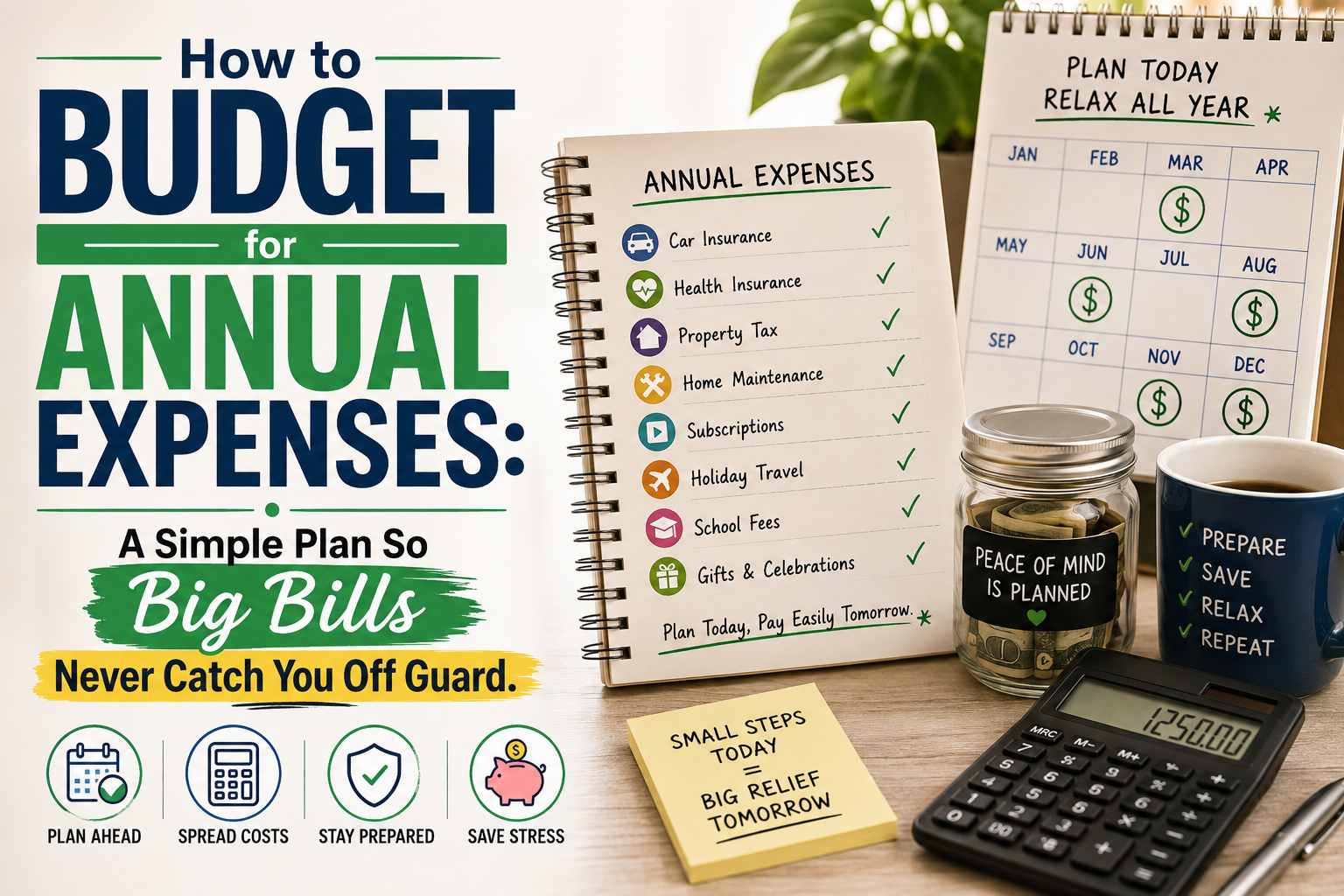
Your monthly budget looks perfect. Rent is covered, groceries are sorted and you even have a little saved. Then a car insurance renewal lands in your inbox, or the holidays arrive, or your vehicle fails its yearly inspection. Suddenly the money you were so proud of is gone, and your budget feels useless.
If this sounds familiar, you are not bad with money. You are just missing one piece of the puzzle: a plan for annual expenses. These are the bills that show up once or twice a year, and they quietly wreck more budgets than almost anything else. This guide explains how to budget for annual expenses step by step, using methods that work in the USA, the UK and Germany.
What Are Annual Expenses?
Annual expenses are costs that do not come around every month. You might pay them once a year, twice a year or every quarter. They are predictable, yet they feel like surprises because they do not appear in your regular monthly routine.
Here are some common examples:
- Car insurance, home or contents insurance and liability insurance
- Vehicle costs such as registration, road tax, MOT checks or the German TÜV inspection
- Property tax in the USA
- The TV licence in the UK or the broadcasting fee (Rundfunkbeitrag) in Germany, if billed in larger chunks
- Annual subscriptions like software, cloud storage, streaming or shopping memberships
- Holidays and travel
- Birthdays, weddings and Christmas gifts
- Back to school costs
- Professional fees, memberships and course payments
- Tax bills, which matter especially for freelancers and self-employed people
Notice that none of these is a true emergency. You know they are coming. That is exactly why they can be planned for.
Why Annual Expenses Break Most Budgets
A typical monthly budget covers rent, food, transport and bills. It works well until a large payment appears that was never part of the plan. When that happens, most people reach for a credit card, dip into their emergency fund or cut back on saving for a few months.
The problem is not the size of the bill. It is the timing. A $1,200 insurance premium is hard to find in a single month. But $100 a month is easy to find. Your annual expenses cost the same either way. The only thing that changes is how you prepare for them.
There is also a mental trap here. When a big bill is not in your budget, it feels like bad luck. When it is part of the plan, it feels like a normal payment. That shift alone can reduce a surprising amount of money stress.
The Core Idea: Sinking Funds
The best tool for annual expenses is called a sinking fund. A sinking fund is money you set aside in small amounts each month for a specific future cost. When the bill arrives, the money is already waiting.
Here is the basic formula:
Annual cost ÷ 12 = monthly amount to save
If your car insurance costs £840 a year, you save £70 a month. If you expect to spend $600 on holiday gifts, you save $50 a month. If your yearly tax bill is €2,400, you save €200 a month.
You are not saving extra money. You are simply moving your spending from one big painful payment into twelve small comfortable ones.
Step 1: List Every Annual Expense
Start by building a complete list. Many people miss things because they only think about what they paid recently. Instead, look back through your records.
Go through your bank and card statements for the last 12 months. Look for large payments that appeared only once or twice. Check your email for renewal notices, invoices and receipts. Look at your calendar for birthdays, events and trips.
Then think ahead. Do you need new tyres soon? Is a laptop due for replacement? Is your child starting a new school year? Will you travel to see family? Add anything you can reasonably expect in the next 12 months.
At the end of this step, you should have a written list of every expense that does not happen monthly.
Step 2: Put a Realistic Price on Each One
Next, attach a number to each item. For fixed costs like insurance, use the exact renewal price. For flexible costs like holidays and gifts, use last year’s spending as a guide, then adjust if needed.
When you are unsure, round up. It is far better to save slightly too much than slightly too little. Prices also tend to rise each year, so a small buffer is wise.
For irregular repairs, such as car maintenance or home fixes, it helps to use an average. A common rule is to set aside 1% to 2% of your home’s value each year for maintenance if you are a homeowner. For cars, many people budget a fixed monthly amount, such as $50, £40 or €45, and let it grow until it is needed. These are rough guides, so adjust them to your own situation.
Step 3: Divide by 12 and Add It Up
Now divide each annual cost by 12. Then add all the monthly amounts together. This final number is the total you need to set aside every month for your annual expenses.
Here is a sample list for someone in the United States:
- Car insurance: $1,200 per year, which is $100 a month
- Vehicle registration and servicing: $600 per year, which is $50 a month
- Holidays and travel: $2,400 per year, which is $200 a month
- Gifts and celebrations: $720 per year, which is $60 a month
- Annual subscriptions: $240 per year, which is $20 a month
- Medical and dental extras: $600 per year, which is $50 a month
The total comes to $480 a month. That might look like a lot at first. But remember, you were already paying these costs. They just were not showing up in your monthly numbers. Now your budget reflects reality.
Step 4: Decide Where to Keep the Money
Where you store your sinking fund matters. You want the money to be safe, easy to reach and slightly separate from your daily spending account, so you are not tempted to use it.
You have three simple options.
One savings account with a spreadsheet. You keep all sinking fund money in one account and track how much belongs to each category in a spreadsheet. This is cheap and flexible, but it needs a little discipline.
Separate pots or sub-accounts. Many banks and apps let you create labelled pots for different goals. In the UK, apps like Monzo and Starling offer this. In Germany, some banks and banking apps provide sub-accounts or “Unterkonten.” In the USA, many online banks let you create multiple savings buckets.
A dedicated savings account. A high-yield savings account in the USA, an easy-access savings account in the UK or a Tagesgeldkonto in Germany can earn interest while the money waits. Check current rates and protection limits before choosing, since they change often.
Avoid putting short-term sinking funds into investments that can drop in value. You may need the cash at a fixed date, so safety matters more than growth.
Step 5: Automate the Transfers
This step is what makes the whole system work. Set up an automatic transfer for your sinking funds on the day after payday. If you wait until the end of the month, the money may already be gone.
Treat this transfer like rent. It is not optional and it is not “what is left over.” It is a bill you pay to your future self.
If your income is tight, you do not have to fund every category at once. Start with the most important and most certain bills, like insurance and taxes. Add holidays and gifts as your budget allows.
Step 6: Handle Irregular Income
If you are a freelancer, contractor or gig worker, annual expenses need even more attention. Your income may swing wildly, and you may also owe tax in large lump sums.
The best approach is to give every payment you receive a job straight away. When a client pays you, split the money into three parts: tax, annual expenses and spending money. Many self-employed people set aside 25% to 30% of each payment for tax, though the right percentage depends on your income and country. In the USA, that often means quarterly estimated tax payments. In the UK, it means a Self Assessment bill with payments on account. In Germany, it can mean an income tax payment after your return is assessed, plus prepayments in some cases.
These rules change and vary by situation, so speak to a qualified tax adviser for your exact numbers.
Step 7: Check for Savings When You Pay Annually or Monthly
Some bills let you choose between paying once a year or paying monthly. Insurance and subscriptions often work this way. Paying monthly sounds easier, but it can cost more because providers sometimes add interest or admin fees.
If you have your sinking fund ready, paying annually can save you money. Compare both prices before deciding. If the annual payment is cheaper, your sinking fund lets you take advantage of that discount without any stress.
In the same way, renewal time is a perfect moment to shop around. Many insurers raise prices for existing customers, and a quick comparison can cut your bill significantly. The earlier you check, the more time you have to switch.
Real-Life Examples
Here are three examples of how this works in practice.
Megan, 32, lives in Denver. She used to dread the months when her car insurance, registration and a family trip all landed close together. She listed her annual costs, which came to about $5,400. Dividing by 12, she set up an automatic transfer of $450 a month into a separate savings account. Now when a bill arrives, she simply pays it from the fund and feels no panic.
Oliver, 40, lives in Birmingham. He realized that Christmas, car tax, the MOT and home insurance were all draining his credit card each year. His total was about £3,600. He set up a monthly standing order of £300 into a labelled savings pot. For the first time in years, he went into December without borrowing.
Annika, 35, lives in Frankfurt. She is a freelance designer, so her income changes every month. She splits each client payment into tax, annual costs and living expenses. Her annual costs include health insurance extras, software subscriptions, a yearly trip and a tax prepayment. She keeps this money in a Tagesgeld account, and she says the system has made her income feel far more stable.
Common Mistakes to Avoid
Even a simple method can go wrong if you are not careful.
The first mistake is forgetting expenses. The list in step 1 is the foundation. Review it twice a year, and add any new costs that appear.
The second mistake is underestimating costs. Prices rise, and life events happen. Build in a small cushion of 5% to 10% so a price increase does not break your plan.
The third mistake is raiding the fund. It is tempting to borrow from your sinking fund for a weekend trip or a sale. If you do, pay it back quickly, or change your plan on purpose instead of by accident.
The fourth mistake is confusing sinking funds with an emergency fund. They are different. A sinking fund is for known costs. An emergency fund is for genuine surprises. You need both.
The last mistake is starting too big. If the total looks overwhelming, begin with two or three key categories. A partial plan is far better than no plan.
Quick Tips to Make It Easier
A few small habits will help your system last.
Name your pots clearly, such as “Car,” “Holidays” or “Taxes.” A clear label makes money harder to spend on something else. Review your annual list at the start of each year and update the amounts. If a bill is lower than expected, move the extra money to another goal. When you get a pay rise, increase your sinking fund contributions first. And when you reach the end of the year with money left in a category, celebrate it. That is a win.
Final Thoughts: Turn Big Bills Into Small Habits
Budgeting for annual expenses is one of the simplest ways to make your finances calmer. You do not need to earn more or live on less. You just need to spread large, predictable costs across the whole year so they stop feeling like emergencies.
Start this week. Write down every annual expense you can think of, divide each one by 12 and set up your first automatic transfer. Within a few months, you will notice a real difference. Bills will arrive, you will pay them, and your budget will stay intact.
That quiet confidence is what good budgeting feels like.