
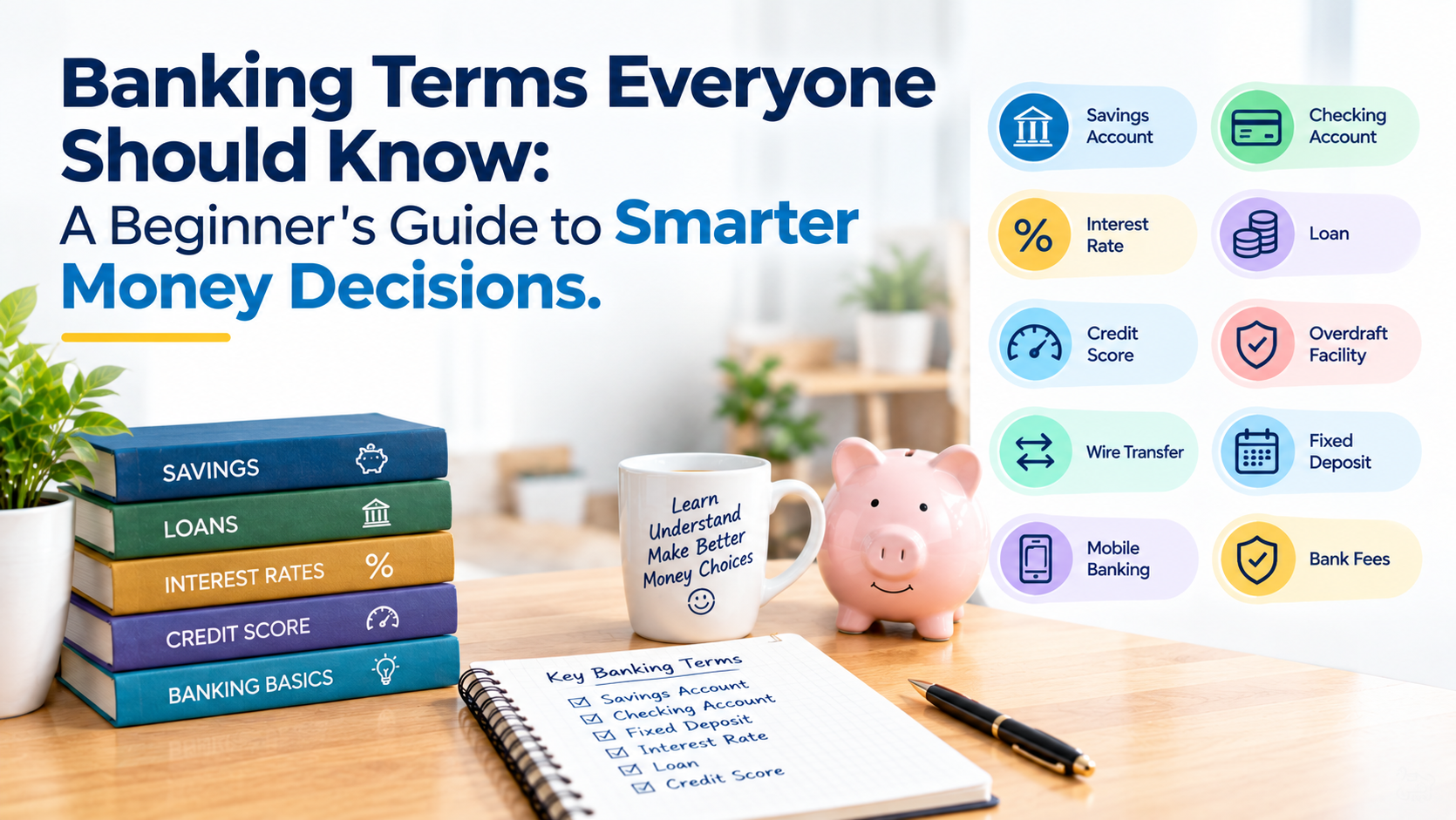
Have you ever looked at a bank statement and felt like it was written in another language? You are not alone. Words like APR, overdraft and KYC get thrown around every day, yet many of us nod along without knowing what they really mean. That confusion can cost real money. A missed detail in a loan form or a charge you did not understand can quietly eat into your savings.
The good news is that you do not need a finance degree to feel confident. Once you learn the most common banking terms, everything gets easier, from opening your first account to applying for a home loan. In this guide, we break down the essential banking terms in plain language, with simple examples you can relate to. By the end, you will understand your bank a lot better and make smarter choices with your money.
Why Learning Basic Banking Terms Matters
Banks use a lot of technical language, and it is not always easy to follow. When you do not understand a term, you tend to trust whatever you are told. That is risky, because the choices you make at the bank can affect your finances for years.
Think about a simple situation. A friend takes a personal loan because the monthly payment looks small. What he did not notice was the long loan term and the high interest rate, so he ends up paying almost double in the end. If he had understood two or three basic banking terms, he could have compared offers properly and saved a lot of money.
Knowing the language also protects you from fraud and hidden fees. It helps you ask the right questions, read the fine print and negotiate when needed. Let us start with the basics.
Everyday Account Terms
These are the words you will hear the moment you walk into a bank or open a banking app.
Savings Account
A savings account is the most common type of bank account for personal use. You keep your money here safely and earn a small amount of interest on it. It works well for your emergency fund and for money you want to set aside but still reach quickly.
Many savings accounts come with a debit card and access to online banking. Some banks ask you to maintain a minimum balance or limit how many withdrawals you can make each month, so always check these rules before opening an account. Interest rates on savings accounts are usually lower than other options, so treat it as a place for safety and easy access, not for growing wealth.
Checking Account (Current Account)
A checking account, called a current account in many countries, is built for everyday spending. You use it for your salary, bills, card payments and transfers. It allows unlimited deposits and withdrawals, and it usually pays little or no interest.
Certificate of Deposit or Fixed Deposit
A certificate of deposit (CD), also known as a fixed deposit or term deposit, lets you park a lump sum for a set period, such as one year or five years, at a fixed interest rate. The rate is usually higher than a savings account. In return, you agree not to touch the money until the period ends. If you withdraw early, the bank charges a penalty.
For example, if you deposit $10,000 for one year at 5 percent, you will get roughly $10,500 when it matures. It is a safe option for people who want predictable returns without any market risk.
Interest Terms That Affect Your Money
Interest is the heart of banking. It is either what you earn or what you pay, so understanding it is a must.
Interest Rate
The interest rate is the percentage a bank pays you for keeping money with them, or the percentage it charges you for lending you money. It is usually shown per year. A higher rate is good when you save and bad when you borrow.
Simple Interest vs Compound Interest
Simple interest is calculated only on the original amount. If you put in $1,000 at 10 percent simple interest, you earn $100 every year, no matter how long you wait.
Compound interest is calculated on your original amount plus the interest already earned. In the second year, you earn interest on $1,100, not just $1,000. This is often called interest on interest, and over many years it makes a big difference. That is why starting to save early matters so much. When you borrow, though, compounding works against you, which is why unpaid credit card balances grow so fast.
APR and APY
APR, or annual percentage rate, shows the true yearly cost of a loan, including the interest and certain fees. Two loans may show the same interest rate, but the one with the lower APR is usually cheaper. When comparing loan offers, always ask for the APR and not just the headline rate.
APY, or annual percentage yield, is the savings side of the same idea. It shows how much you will really earn in a year once compounding is included. Comparing APY across banks gives you a fair picture of which savings account pays more.
Borrowing and Loan Terms
Sooner or later, most of us borrow money for a home, a vehicle, education or an emergency. These terms will help you do it wisely.
Principal
The principal is the original amount you borrow. If you take a loan of $20,000, that figure is your principal. Interest is charged on it, and every time you repay, a part of your payment reduces the principal.
Monthly Installment (EMI)
A monthly installment, sometimes called an EMI, is the fixed amount you pay your lender every month until the loan is cleared. It has two parts, the interest and a portion of the principal. In the early months, a bigger share goes towards interest. Later, more of it goes towards the principal.
Before taking any loan, check whether the payment fits comfortably in your monthly budget. A common tip is to keep all your debt payments together under 35 to 40 percent of your monthly income.
Loan Term
The loan term, also called tenure, is the length of time you have to repay a loan. A longer term gives you a smaller monthly payment but makes you pay more interest overall. A shorter term means a higher payment but a lower total cost. Pick the balance that suits your income.
Credit Score
A credit score is a number that shows how reliable you are as a borrower. The scale depends on your country and the agency, but many systems range from about 300 to 850 or 900, and higher is always better. Lenders check it before approving loans, mortgages and credit cards.
You can improve your score by paying bills on time, keeping credit card usage low and avoiding too many loan applications in a short time. Check your credit report once or twice a year, because errors do happen and they are worth fixing.
Collateral
Collateral is an asset you pledge to the bank as security for a loan. A mortgage uses the house itself as collateral. If you stop paying, the bank has the right to recover its money by selling that asset. Loans without collateral, such as personal loans, are called unsecured loans, and they often carry higher interest rates.
Overdraft
An overdraft allows you to spend more money than you actually have in your account, up to a set limit. It is helpful during a cash crunch, but the fees or interest are usually high. Use it for short term needs only and clear it quickly.
Payment and Digital Banking Terms
Banking has moved onto our phones, and a whole new set of words came along with it.
Online Banking and Mobile Banking
Online banking lets you manage your account through your bank’s website, while mobile banking does the same through an app. You can check your balance, pay bills, transfer money and even open deposits without visiting a branch. Always use the official app and never log in through links sent by strangers.
Bank Transfers: ACH, SEPA and Wire Transfers
A bank transfer moves money from one account to another. Domestic systems such as ACH in the United States or SEPA in Europe are slower but cheap or free, which suits regular payments like rent. A wire transfer is faster and works for large or urgent amounts, but banks usually charge a fee for it. Knowing the difference helps you pick the right method and avoid unnecessary costs.
IBAN and SWIFT Code
When you send money abroad, you need two details. The IBAN is an international account number used in many countries, and the SWIFT or BIC code identifies the receiving bank. Some countries use their own routing or sort codes instead. A single wrong digit can delay or misdirect your payment, so double check everything before you hit send.
Security and Compliance Terms
Staying safe is just as important as saving money. These terms are about protecting your account.
KYC (Know Your Customer)
KYC is the process banks use to verify who you are. You usually submit an ID proof, an address proof and sometimes a photograph. It helps prevent fraud and money laundering. If your information is not up to date, your bank may limit or freeze your account, so keep your documents current.
One Time Passwords and Two Factor Authentication
A one time password, or OTP, is a short code sent to your phone to confirm a transaction. Two factor authentication adds this second layer of protection on top of your password. Remember one rule: no genuine bank employee will ever ask for your OTP, PIN or full card details. If someone does, it is a scam.
Fees and Charges to Watch Out For
Banks earn from services, and small charges can add up without you noticing. Common ones include monthly account fees, annual card fees, ATM fees after the free limit, foreign transaction fees, loan processing fees and penalties for late payments. Ask your bank for a full list of charges when you open an account or take a loan, and review your statement every month so nothing slips by.
Practical Tips to Use Banking Terms in Real Life
Knowing the words is only the first step. Here is how to put them to work:
- Compare before you commit. Check the interest rate, APR, loan term and fees across at least three banks.
- Build an emergency fund. Keep three to six months of expenses in your savings account.
- Automate good habits. Set up a monthly transfer so saving happens without effort.
- Protect your credit score. Pay every loan and credit card bill before the due date.
- Stay alert online. Never share your OTP, PIN or passwords, and verify any message that claims to be from your bank.
- Read the fine print. If a term in the agreement is unclear, ask the bank to explain it in simple words.
Conclusion
Banking does not have to feel complicated. Once you understand the basic banking terms, such as savings account, interest rate, APR, credit score, wire transfer and KYC, you can read statements with confidence, borrow wisely and spot problems early. These small pieces of knowledge add up to better financial habits and fewer costly surprises.
Start today. Pick two or three terms from this guide that you were unsure about and look at how they appear in your own account or loan papers. Then share this post with a friend or family member who could use the same clarity. The more you know, the more control you have over your money.