
Life does not send a warning before it sends a bill. The car breaks down. The roof leaks. A medical expense lands in your lap. Or maybe it is a happy moment, like a wedding or a move to a new city, and the cost is bigger than your bank balance. In every one of these moments, you face the same choice: put it on a credit card or take out a personal loan?
Most guides explain the two products in general terms. This one takes a different approach. Instead of asking which product is better in theory, we ask which one is better for the situation you are actually in. A credit card is brilliant for some jobs and terrible for others. A personal loan is the opposite. Once you match the tool to the task, the choice becomes much easier.
In this guide on credit card vs personal loan, you will see how each one works in simple terms, how six common situations play out with real numbers, and a quick set of questions you can use before you borrow a single dollar.
The Short Version: How They Differ
Before the scenarios, here is the core difference in a few lines.
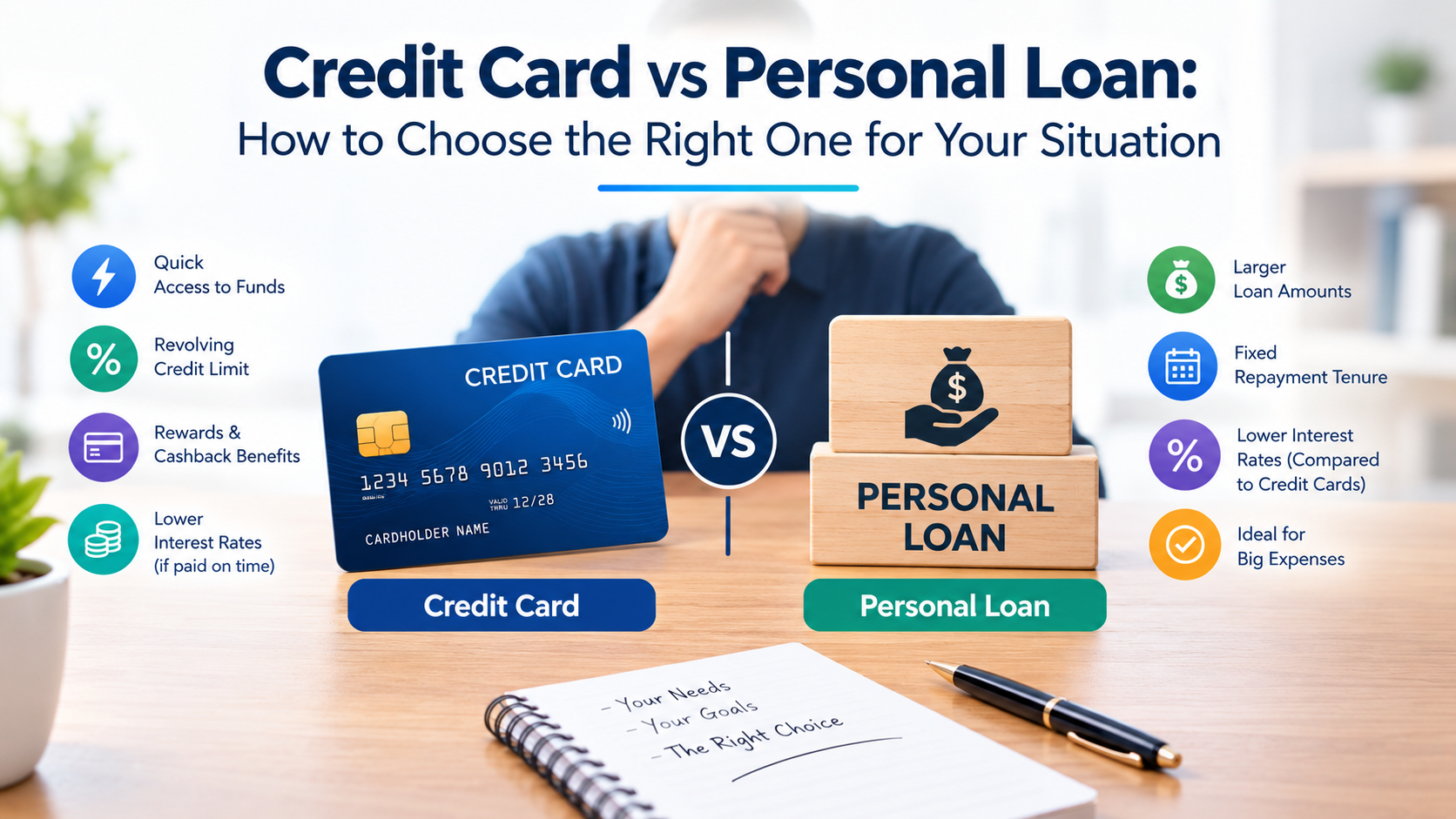
A credit card is open ended. You get a limit, spend what you like up to it, and repay in whatever amounts you choose, as long as you meet the minimum. Interest is charged only if you carry a balance past the due date, and the rate is usually high.
A personal loan is closed ended. You borrow one fixed amount, receive it at once, and repay it in equal payments over a set time. The rate is usually lower than a card, and it is often fixed, so the payment never changes.
Think of a credit card as a tap you can leave running, and a personal loan as a bucket with a known size. The tap is handy for small, quick jobs. The bucket is better when you know exactly how much you need.
| Feature | Credit Card | Personal Loan |
|---|---|---|
| Structure | Revolving limit | Fixed lump sum |
| Repayment | Flexible, minimum required | Fixed monthly payments |
| Interest rate | Usually higher | Usually lower |
| Payoff date | None unless you set one | Set from the start |
| Typical size | Small to medium | Medium to large |
| Extras | Rewards, protections, promo rates | Predictability |
| Risk | Overspending, long debt | Fees, fixed commitment |
Situation 1: A Surprise Emergency Today
Say your car needs a $1,200 repair, and you need it back on the road by tomorrow.
The better pick: credit card. Speed is the deciding factor. A card is already in your wallet, and the repair shop takes payment instantly. A personal loan, even a fast online one, usually takes at least a day or two.
The key is what happens next. If you can pay the bill in full by the due date, you may pay no interest at all. If you cannot, set a plan to clear it within a few months, or move it to a cheaper loan later. The danger of the card is not the card itself. It is leaving the balance sitting there at a high rate with no end date.
Situation 2: A Planned Home Repair or Renovation
Now imagine you need $8,000 to fix a roof. You know the amount, and you will repay over about two years.
The better pick: personal loan. This is a classic case where the loan wins.
Here is the math. A personal loan at 11 percent over 24 months costs about $373 a month, with total interest of roughly $949. Now put the same $8,000 on a card charging 21 percent and pay the same $373 each month. It would take about 28 months to clear, and you would pay around $2,118 in interest. That is more than double the cost, and four extra months of payments.
When the amount is large, the repayment period is long and you know the number in advance, the lower rate and fixed schedule of a loan save real money.
Situation 3: A Medical Bill You Can Spread Out
A $2,500 medical bill arrives, and you can handle about $210 a month.
The better pick: it depends on a 0 percent offer. First, ask the provider about a payment plan, since many hospitals and clinics offer interest free instalments. This is often the cheapest route of all.
If that is not available, compare two options. A card with a 0 percent introductory rate for 12 months lets you split the $2,500 into 12 payments of about $208 with no interest, provided you clear it before the offer ends. Without that promotional rate, a regular card at 21 percent would cost roughly $293 in interest even over a year. In that case, a small personal loan at a lower rate would be cheaper.
The lesson is that a card can be the best option when it comes with a real 0 percent offer and you have the discipline to pay it off in time. It becomes the worst option the day the promotion ends.
Situation 4: Consolidating Existing Debt
Suppose you already carry $9,000 across a few credit cards at an average of 23 percent, and you pay $300 a month in total.
The better pick: personal loan. This is one of the most common and sensible uses of a personal loan.
Keep paying $300 on the cards, and it takes about 46 months to clear, with roughly $4,521 in interest. Instead, take a personal loan of $9,000 at 12 percent over 36 months. Your payment is about $299, almost identical, but you finish ten months sooner and pay about $1,761 in interest. That is a saving of around $2,700, with no change to your monthly budget.
There is one important warning. Consolidation only works if you stop using the cards for new spending. Otherwise, you end up with the loan plus fresh card debt, which is worse than where you started. Some people choose to keep the cards but leave them at home, or set a low limit.
A balance transfer card with a 0 percent introductory rate is another way to consolidate. It can work well for smaller amounts you can clear within the promotional period. Check the transfer fee, which is usually a few percent of the amount moved.
Situation 5: A Big Life Event Like a Wedding or a Move
You are planning a wedding and expect to spend $15,000, or you are relocating to another city and need money for deposits, transport and furniture.
The better pick: personal loan, with a card for small extras. Large, one time costs with a known total suit a loan. You get the full amount at a fixed rate and a payment schedule you can plan around. Putting $15,000 on a card could eat most of your limit, spike your credit utilization and hurt your credit score.
That said, a card is still useful for parts of the spending. Booking flights, hotels and deposits on a rewards card can earn points, and many cards add purchase protection. The smart approach is to use the card for pieces you can repay quickly, and the loan for the large remainder you will repay over time.
Situation 6: Everyday Spending and Small Purchases
You need a new laptop for $900, or you want to cover regular monthly bills and shop online.
The better pick: credit card, paid in full. For small and short term spending, a personal loan is too slow and often too large. A card makes more sense, especially if it offers cashback or points.
The condition, once again, is to pay the full balance every month. If you do, you get the convenience, the rewards and the protections for free. If you do not, the interest cancels everything.
What About Your Credit Score?
Both products affect your credit score, but in different ways, and it helps to understand how.
A credit card affects your credit utilization, which is the share of your limit that you are using. Keeping it under about 30 percent helps your score, while maxing out the card hurts it. Payment history matters most of all, so pay on time every month.
A personal loan adds an installment account to your credit mix, which can help over time. Applying causes a small, temporary dip because of the hard inquiry. After that, steady on time payments build a positive record. And as mentioned earlier, using a loan to pay down card balances can lower your utilization and lift your score, provided you do not run the cards up again.
The Hidden Costs on Each Side
Looking only at interest rates can mislead you. Both products have costs that sit in the fine print.
For credit cards, watch for annual fees, late payment fees, cash advance fees and foreign transaction fees. A promotional 0 percent rate can end suddenly, and the rate that follows is often steep. Rewards can also tempt you into spending more than you planned.
For personal loans, watch for origination fees, which are often 1 to 8 percent of the loan and are deducted from the money you receive. Some lenders charge penalties for repaying early. Late payments bring fees as well, and a long term lowers your payment but raises the total interest.
The best way to compare is to ask for the APR, which combines the interest and many fees into one yearly figure.
Who Should Lean Towards Each Option?
A credit card tends to suit you if you pay your balance in full each month, you value rewards and protections, your expenses are small or short term, and you are comfortable with a flexible, open ended repayment.
A personal loan tends to suit you if you need a larger sum, you want a fixed payment and a clear end date, you are consolidating higher interest debt, or you know you are tempted to overspend and a rigid plan will keep you on track.
If you fall in between, remember that you can use both. A card for small, quick purchases and a loan for a major expense is a perfectly sensible mix.
Five Questions to Ask Before You Borrow
Before you decide, take two minutes to answer these.
- How much do I need, exactly? For a fixed, larger amount, lean towards a loan. For a small or uncertain amount, a card is more flexible.
- How quickly can I repay it? Within a month or two, a card works well. Over a year or more, a loan is usually cheaper.
- Is there a real 0 percent offer I can use? If so, and you can clear it in time, a card may cost nothing.
- What is the APR on each option? Compare the full cost, not just the headline rate or monthly payment.
- Will I stick to the plan? If you are likely to overspend or only pay the minimum, a fixed loan schedule can protect you.
Write down the answers, then compare two or three real offers. A quick check with a loan calculator takes only a few minutes.
Common Mistakes to Avoid
Several errors come up again and again. One is treating a card’s minimum payment as a plan, when it is only a way to stay in good standing. Another is picking the loan with the smallest monthly payment without checking the total cost.
Some people take a consolidation loan and then spend on the cleared cards, doubling their debt. Others forget about fees and are surprised when the loan arrives smaller than expected. And some apply for several loans and cards at once, which creates multiple hard inquiries and can lower their score.
Finally, avoid borrowing more than you need. A larger limit or loan amount can feel comforting, but you pay for every extra dollar you take. If you feel unsure, a qualified financial adviser or a nonprofit credit counselor can review your numbers for free or for a small fee.
Conclusion
The honest answer to credit card vs personal loan is that neither one wins every time. A credit card is the better tool for urgent, small or short term needs, especially when you can pay in full or use a genuine 0 percent offer. A personal loan is the better tool for larger planned expenses, longer repayment and consolidating expensive card debt, thanks to its lower rate and fixed schedule.
The smartest move is to match the product to your situation. Ask how much you need, how fast you can repay and what the total cost will be. Then compare real offers using the APR. Before you borrow anything, take ten minutes today to write down the amount you need and the monthly payment you can comfortably afford. Use that as your guide, and you will pick with confidence. If this guide helped, share it with someone who is facing a big expense right now.