
You have found a personal loan that looks good. The amount is right, the lender seems trustworthy, and then comes a question that stops many people in their tracks: do you want a fixed rate or a variable rate? It sounds like a small detail, but this one choice can change how much you pay every month and how much you pay in total.
The trouble is that most lenders explain it in a hurry, using words that sound the same to a beginner. In this guide, we explain fixed vs variable interest rates in simple language. You will see how each one works, where each one shines, where it can hurt, and how to decide based on your own situation. Let us get started.
What Is an Interest Rate on a Personal Loan?
Before comparing the two types, it helps to be clear on what an interest rate really is. When you borrow money, the lender charges you a fee for using it. That fee is shown as a percentage of the amount you owe, usually per year. A higher rate means a more expensive loan, and a lower rate means a cheaper one.
On a personal loan, you borrow a fixed amount and repay it in equal monthly payments over a set period, often one to seven years. Each payment covers some interest and some of the original amount, which is called the principal. The type of rate you choose decides whether the interest part of your loan stays steady or moves up and down over time.
Fixed Interest Rates Explained
A fixed rate is the simpler of the two, and it is the one most people are familiar with.
How a Fixed Rate Works
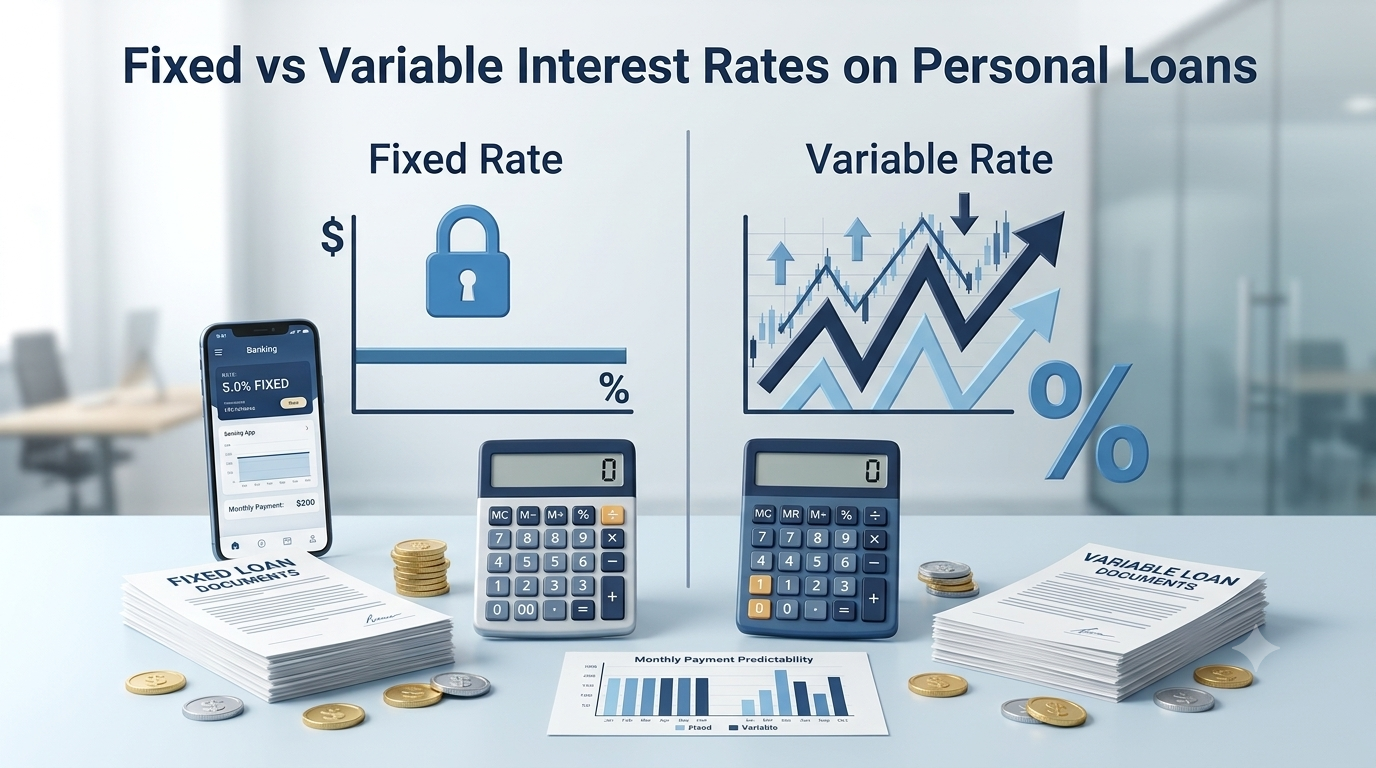
With a fixed rate, the interest rate is locked in on the day you sign the loan. It stays exactly the same until you finish repaying, no matter what happens in the economy. If your rate is 9 percent today, it will still be 9 percent three years from now.
Because the rate never changes, your monthly payment never changes either. You know the exact amount that leaves your account each month, and you know the total cost of the loan from the start.
Advantages of a Fixed Rate
The biggest benefit is certainty. You can plan your budget with confidence, because there are no surprises. This is especially helpful if you have a tight budget, a steady salary and a lot of other bills to manage.
A fixed rate also protects you when interest rates in the wider economy are rising. While other borrowers see their payments go up, yours stays where it is. Many people find that peace of mind worth paying a little extra for.
Disadvantages of a Fixed Rate
The main drawback is that fixed rates often start higher than variable rates. The lender is taking on the risk of future rate changes, so they usually charge a bit more for that promise.
You also miss out if market rates fall. Your rate stays locked, even if new borrowers are getting cheaper loans. Some lenders let you refinance to a lower rate, but that can come with fees, so it is not always free.
Variable Interest Rates Explained
A variable rate is a bit more flexible, and a bit less predictable.
How a Variable Rate Works
A variable rate, also called a floating or adjustable rate, can change during the life of your loan. It is usually linked to a benchmark rate, such as a central bank rate or a widely used market index. Your lender adds a fixed margin on top of that benchmark to arrive at your rate.
For example, if the benchmark is 4 percent and your lender adds a margin of 4 percent, your rate is 8 percent. If the benchmark rises to 5 percent, your rate becomes 9 percent. If it falls, your rate falls too. The rate is reviewed at set times, such as every month, every quarter or once a year, depending on the lender.
Advantages of a Variable Rate
Variable rates often begin lower than fixed rates, which means a smaller monthly payment at the start. That can be attractive if you want to keep your early costs down.
If market rates drop, you benefit automatically, without needing to refinance. Variable loans can also work well for shorter terms, because there is less time for rates to move against you. Some lenders also allow extra repayments on variable loans without penalty, which helps you clear the debt faster.
Disadvantages of a Variable Rate
The risk is obvious. If the benchmark rises, your payment rises with it, and you may not have planned for that. A payment that fit your budget in month one could feel heavy in month eighteen.
This unpredictability makes budgeting harder. It can also be stressful, because you cannot control what central banks or markets do. Some variable loans include a rate cap, which sets a maximum limit, but not all of them do, so you need to check.
Fixed vs Variable: A Real Life Example
Numbers make the difference easier to see. Imagine you borrow $10,000 for three years.
With a fixed rate of 9 percent, your monthly payment is about $318, and it stays that way for all 36 months. Now suppose you choose a variable loan that starts at 7 percent. Your first payment is about $309, which looks like a nice saving.
But what if the benchmark rises and your rate climbs to 11 percent? Your payment would move to roughly $327. On a small, short loan, the gap is only a few dollars a month. That is why the stakes are lower on small loans.
Now look at a bigger one. On a $30,000 loan over five years, a 9 percent rate gives a payment of about $623. If the rate rises to 12 percent, the payment becomes about $667. That is around $45 more each month, or roughly $2,700 more over the full term. The bigger and longer the loan, the more the rate type matters.
Fixed vs Variable Rates at a Glance
| Feature | Fixed Rate | Variable Rate |
|---|---|---|
| Rate during the loan | Stays the same | Can rise or fall |
| Monthly payment | Predictable | Can change |
| Starting rate | Usually higher | Usually lower |
| Best for | Budget certainty | Short terms or falling rate periods |
| Main risk | Missing out if rates fall | Paying more if rates rise |
How to Choose the Right Rate for You
There is no single right answer. The best choice depends on your finances, your comfort with risk and the economy at the time you borrow.
Choose a Fixed Rate If
A fixed rate is usually the safer pick if you have a tight monthly budget and cannot afford a higher payment later. It also makes sense if you are borrowing a large amount, or if your loan term is long, such as five years or more. If you are someone who loses sleep over unpredictable bills, certainty is worth a lot.
Consider a Variable Rate If
A variable rate can make sense if you plan to repay the loan quickly, perhaps within a year or two. It can also suit you if you have some savings or extra income to absorb a rise in payments. If experts expect rates to fall, a variable loan may save you money. Just remember that predictions about interest rates are often wrong, so never rely on them alone.
A simple test is to ask yourself one question: if my payment went up by 20 percent next year, could I still manage comfortably? If the answer is no, a fixed rate is likely the better choice.
Questions to Ask Your Lender Before You Sign
Whichever type you lean towards, ask a few direct questions so there are no surprises later.
- Which benchmark is my variable rate linked to, and how much is the margin?
- How often can the rate change, and how much notice will I get?
- Is there a cap on how high the rate can go?
- What is the APR, including all fees, not just the headline rate?
- Is there a penalty for repaying early or making extra payments?
- Can I switch from variable to fixed later, and what would it cost?
Write the answers down and compare them across at least three lenders. A small difference in fees can matter as much as the rate itself.
Common Mistakes to Avoid
One common mistake is choosing a loan only because the first payment is the lowest. A low starting rate can feel great, but it tells you little about what you will pay later. Another is ignoring the total cost. Always look at the full amount you will repay, not just the monthly figure.
People also forget to read about fees. Origination fees, late payment charges and early repayment penalties can quietly add to the cost of either type of loan. Finally, do not stretch the loan term just to shrink the payment. A longer term means more interest overall, whether your rate is fixed or variable. If you are unsure, speaking with a qualified financial adviser can help you decide based on your own numbers.
Conclusion
Choosing between fixed vs variable interest rates comes down to a trade off. A fixed rate gives you stability and a clear picture of what you will pay. A variable rate can start cheaper and may save you money if rates fall, but it comes with the risk of higher payments later.
If you value certainty, have a long loan term or a tight budget, a fixed rate is usually the comfortable choice. If you are borrowing for a short period and can handle some ups and downs, a variable rate may be worth considering. Whatever you decide, compare offers, check the APR and read the terms carefully. Take a few minutes today to run the numbers for your own loan, and share this guide with someone who is about to borrow. A little homework now can save you a lot of money later.