
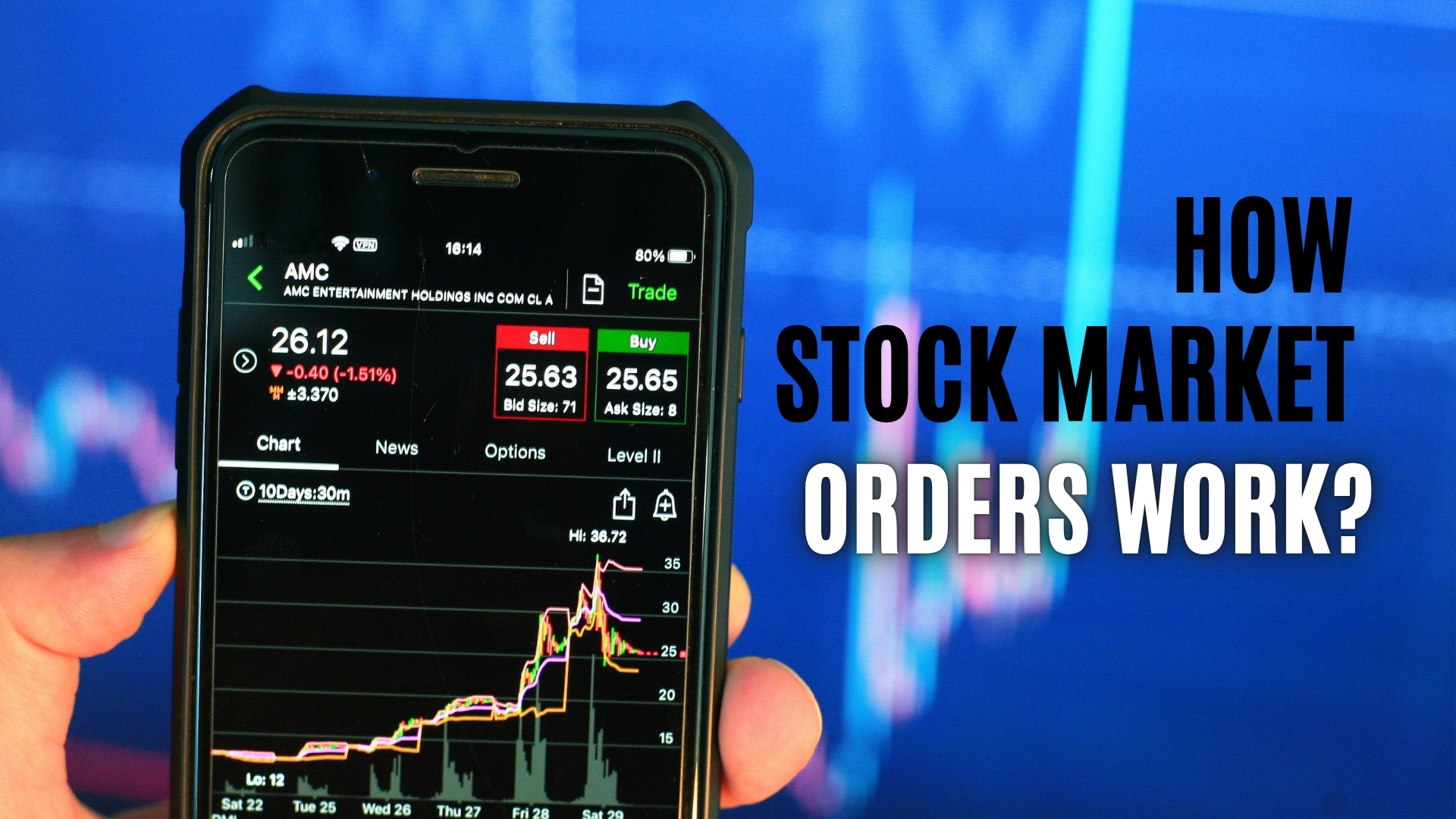
You open your brokerage app, search for a stock and tap the buy button. Then a screen appears with choices that look unfamiliar: market, limit, stop, stop-limit, day, good until canceled. Many beginners freeze at this point. Some tap the first option and hope for the best. Others close the app and decide to try again later.
That hesitation is understandable, because the type of order you choose can change the price you pay, whether you get your shares at all and how much you lose if the market moves against you. Two investors can place a trade on the same stock at the same moment and end up with different results simply because they picked different orders.
The good news is that stock market orders are not complicated once someone explains them in plain language. In this guide, you will learn how stock market orders work from start to finish. We will cover what happens when you press the button, the most common order types, how long an order stays active, why orders sometimes fill only in part and how to avoid the mistakes that trip up new investors.
What Is a Stock Market Order?
An order is simply an instruction you give your broker to buy or sell a security under certain conditions. At minimum, it includes the stock you want, whether you are buying or selling, the number of shares and the type of order. The order type tells the broker how you want the trade carried out, especially when it comes to price and timing.
It helps to think of it like shopping. You can walk into a store and pay whatever the price tag says right now. Or you can say, “I will only buy this if the price drops to a certain level.” Or you can leave a note that says, “If the price falls too low, sell it for me.” Each of these is a different kind of order, and each fits a different goal.
How an Order Travels From Your Phone to the Market
When you place an order, your broker sends it to a place where buyers and sellers meet. That might be a stock exchange, an electronic trading network or a market maker, which is a firm that stands ready to buy and sell shares. Brokers are required to seek good execution for their clients, which means looking for a fair price and a quick fill.
At the heart of every exchange is the order book. This is a live list of all the orders waiting to be matched. On one side are buy orders, with the prices buyers are willing to pay. On the other side are sell orders, with the prices sellers are asking. When a buyer and seller agree on a price, a trade happens.
Most markets match orders using price and time priority. The highest buy price and the lowest sell price go first. If several orders are at the same price, the one that arrived earlier goes first. This explains why placing an order sooner can sometimes help you get filled when the market is busy.
Understanding Bid, Ask and Spread
Before looking at order types, you need to understand three prices you will see on every stock quote.
The bid is the highest price a buyer is currently willing to pay. The ask, sometimes called the offer, is the lowest price a seller is currently willing to accept. The spread is the gap between them.
Suppose a stock shows a bid of $49.95 and an ask of $50.05. The spread is ten cents. If you want to buy immediately, you will usually pay the ask, which is $50.05. If you want to sell immediately, you will usually receive the bid, which is $49.95. The last traded price you see on the screen may be somewhere in between, and it is not a guarantee of what you will get.
For popular, heavily traded stocks, the spread is often just a cent or two. For smaller or less active stocks, it can be much wider. A wide spread is a hidden cost, because you lose a little every time you buy and sell.
Market Orders: Fast but Not Price-Controlled
A market order tells your broker to buy or sell right away at the best available price. It is the simplest order and the one most beginners use first.
The big advantage is speed and certainty of execution. In normal conditions, a market order for a widely traded stock will fill within moments. If you place a market order to buy 100 shares of the stock above, you would likely pay around $50.05 per share, so about $5,005 in total.
The drawback is that you do not control the price. In a calm market with lots of trading, the price you get is usually very close to what you see. But when a stock is thinly traded, or when the price is moving fast, the fill can come at a noticeably worse price than you expected. This difference between the expected price and the actual price is called slippage.
Market orders work best for large, liquid stocks and funds when you care more about getting in or out quickly than about a few cents of difference. They are a poor choice for thinly traded stocks, and for times when prices are jumping around, such as just after the market opens or right after big news.
Limit Orders: You Set the Price
A limit order lets you name the price. A buy limit order says, “Buy this stock, but pay no more than this amount.” A sell limit order says, “Sell this stock, but accept no less than this amount.”
Imagine a stock trades at $50 and you think that is a little high. You place a buy limit order at $49.50. If the price falls to $49.50 or lower, your order can fill. If the price never drops that far, the order simply waits, and you never buy. In the same way, if you own shares and want at least $55 for them, you can place a sell limit order at $55 and wait for the market to reach it.
The advantage is price control. You will never pay more or receive less than your limit. The drawback is that there is no guarantee the order will fill. The market may never reach your price, or it may touch it briefly without enough trading volume to complete your order. Some investors miss out on a good stock because they were unwilling to pay a few cents more.
Limit orders are a smart choice for less liquid stocks, for volatile markets and for any time you have a specific price in mind. Many experienced investors use them by default.
Stop Orders: A Trigger for Selling or Buying
A stop order, often called a stop-loss order, is an instruction that becomes active only when the stock reaches a certain price, called the stop price. Once that price is touched, the stop order turns into a market order and executes at the next available price.
The most common use is protection. Say you bought shares at $50 and you do not want to lose more than about 10 percent. You place a sell stop order at $45. If the price falls to $45, your order triggers and your shares are sold at the market. This can limit your loss without you needing to watch the screen all day.
Stop orders can also be used to buy. A buy stop order triggers when the price rises to a level above the current price. Some investors use it to enter a stock once it breaks out above a resistance level.
There is an important catch. Because a stop order becomes a market order when triggered, you are not guaranteed the stop price. If the stock gaps down overnight, perhaps because of bad earnings news, and opens at $42, your $45 stop will trigger and your shares will be sold near $42, not $45. In fast markets, the final price can be quite different from the stop price.
Stop-Limit Orders: A Trigger With a Price Limit
A stop-limit order combines the two ideas above. It has two prices: a stop price that activates the order, and a limit price that sets the worst price you will accept.
Using the same example, suppose you own shares at $50 and place a sell stop-limit with a stop at $45 and a limit at $44. If the price falls to $45, the order becomes a limit order to sell at $44 or better. This protects you from selling at a terrible price in a sharp drop.
The trade-off is that the order might not fill at all. If the stock gaps down to $42, it jumps right past your $44 limit, and your order sits unfilled while the price keeps falling. You avoided a bad sale price but remained in a falling stock. This is the main risk of stop-limit orders, and it is why they require careful thought.
Trailing Stop Orders: A Stop That Follows the Price
A trailing stop is a stop order that moves with the stock price. You set it as a fixed amount or a percentage below the market price for a sell order. As the price rises, the stop rises too. If the price falls, the stop stays where it is.
For example, you buy at $50 and set a 10 percent trailing stop. The initial stop sits at $45. If the stock climbs to $60, the stop moves up to $54. If the stock then falls to $54, your shares are sold. The order locks in some of the gains while still giving the stock room to grow.
The benefit is that you do not have to keep adjusting the stop by hand. The risk is that normal ups and downs in the price can trigger the sale too early. If your trailing amount is too tight, a small dip can force you out of a stock that was about to recover.
How Long Does an Order Last? Time in Force
Besides the order type, you usually choose how long the order should stay active. This setting is called time in force.
Day order. The order expires at the end of the trading day if it has not been filled. This is the default at many brokers.
Good until canceled (GTC). The order stays active until it fills or you cancel it, though brokers usually set a maximum, often 60 to 90 days.
Immediate or cancel (IOC). The order must fill immediately, in whole or in part, and any unfilled portion is canceled.
Fill or kill (FOK). The order must fill completely and immediately, or the entire order is canceled.
For most everyday investors, day and GTC orders are the ones you will use. Be careful with GTC orders. People sometimes forget them, and an old order can fill weeks later at a time when it no longer fits their plans.
Partial Fills and Why Orders Do Not Always Complete
Sometimes an order fills only partly. If you place a limit order to buy 500 shares at $49.50 but only 200 shares are available at that price, you may receive 200 shares first, and the other 300 may fill later, or not at all. Partial fills are common with limit orders, especially in less active stocks.
Brokers may charge commissions per execution in some cases, though many now offer commission-free trading on stocks. It is wise to check your broker’s fee schedule so that partial fills do not surprise you.
Regular Hours, Pre-Market and After-Hours
The main trading session for many exchanges runs for around six and a half hours on weekdays. Outside those hours, some brokers allow trading in extended sessions, called pre-market and after-hours trading.
Extended sessions come with extra risks. There are fewer buyers and sellers, so spreads are wider and prices can swing sharply on small volumes. Many brokers only accept limit orders during these times for that reason. News released after the close, such as earnings, can cause big price changes, and trading right away is not always a good idea. Beginners often do better waiting for the regular session.
Real-Life Example: Choosing the Right Order
Let us walk through a simple scenario to bring it together.
Maya wants to buy 100 shares of a company trading near $50. The stock is popular, with a spread of one cent. She is not in a hurry and wants a slightly better price, so she places a day limit order at $49.50. The price dips to $49.50 that afternoon, and her order fills. She now owns the shares at $49.50.
To protect herself, Maya places a GTC sell stop order at $44.50, which is about 10 percent below her purchase price. A few weeks later, the company reports weak results, and the stock opens the next morning at $41. Her stop triggers and the shares are sold near $41, not $44.50. She loses more than she planned, but far less than if she had held while the price kept sliding.
If Maya had used a stop-limit order with a limit of $44, her order would not have filled at $41, and she would still own the shares. Which outcome is better depends on what happens next, which nobody can know. The lesson is that each order type has strengths and weaknesses, and the right choice depends on your goal.
Common Mistakes Beginners Make
Several errors appear again and again. The first is using market orders on thinly traded stocks, which can lead to poor fills. Another is placing a stop order too close to the current price, so that normal daily moves knock you out of a good investment.
Many new investors assume a stop order guarantees the stop price, which is not true, especially during gaps and fast moves. Others forget about GTC orders and are surprised when they fill later. Some trade during the first few minutes after the market opens, when prices are most chaotic. And some do not check the order screen carefully, accidentally selecting the wrong number of shares or the wrong order type. Always review the order summary before confirming.
Tips for Placing Orders Wisely
Start by using limit orders for most purchases, so you stay in control of the price. Check the bid, ask and spread before you trade, especially for smaller stocks. Avoid placing orders in the first and last few minutes of the session unless you have a reason to, as prices tend to be more volatile then.
Think about your plan before you buy, including where you would sell if things go wrong. Write down your price targets and your exit points, and consider using protective orders if you cannot watch the market. Practice with a paper trading or demo account if your broker offers one. And start small. Learning with a small number of shares is far cheaper than learning with a large position.
Conclusion
Understanding how stock market orders work gives you control over the price you pay, the timing of your trades and the risks you take. A market order buys or sells right away at the best available price. A limit order lets you set the price but may not fill. A stop order helps you manage losses, while a stop-limit order adds a price limit, and a trailing stop follows the price upward. Add the right time in force, and you can match your order to your plan.
No order type is best in every situation. What matters is knowing what each one does and choosing the one that fits your goal. Take a few minutes today to open your broker’s order screen, read each option and, if possible, practice with a demo account. Once the choices stop looking strange, you will trade with far more confidence.
This guide is for education only and is not financial advice. Investing involves risk, including the loss of money, so consider speaking with a qualified financial adviser. If this guide helped, share it with a friend who is learning to invest.