
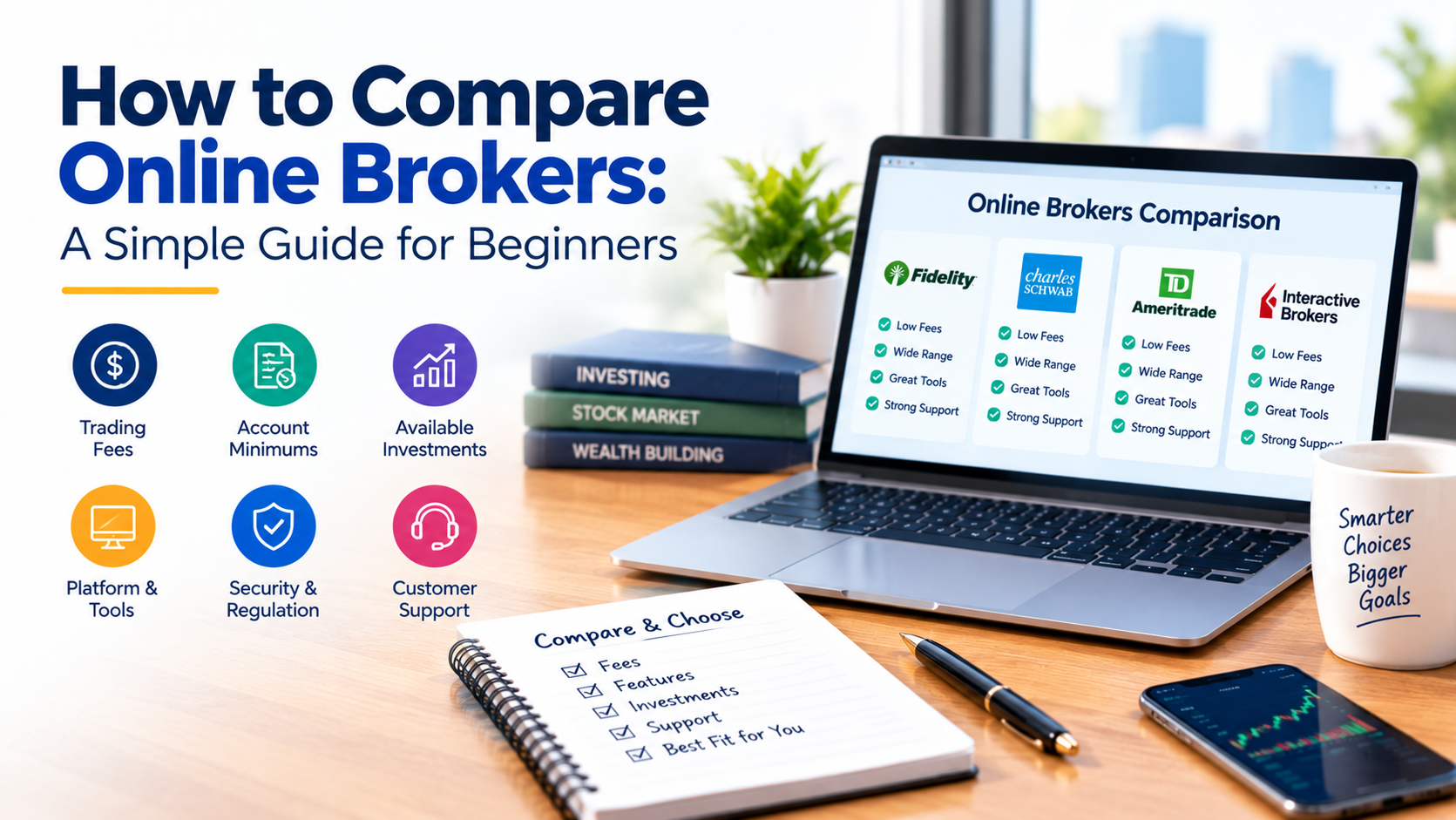
Choosing an online broker can feel confusing. Many platforms advertise low fees, simple apps and quick account opening. But the cheapest-looking broker may not always be the best choice for your needs.
A good broker should offer fair fees, useful investment options, reliable service, strong security and clear information. This guide explains how to compare online brokers in simple language, with a focus on investors in the USA, UK and Germany.
What Is an Online Broker?
An online broker is a company that allows you to buy and sell investments through a website or mobile app.
Depending on the platform, you may be able to invest in:
- Stocks.
- Exchange-traded funds, also called ETFs.
- Mutual funds.
- Bonds.
- Options.
- Futures.
- Foreign currencies.
- Other financial products.
Some brokers only execute your orders. You choose the investments yourself. Other brokers provide research, investment ideas, financial advice or portfolio management.
Before comparing platforms, decide what type of service you need. A beginner who wants to buy a few ETFs may need a simple platform. An active trader may need advanced charts, fast execution and access to several markets.
The US Securities and Exchange Commission explains that brokers and investment advisers may offer different services and charge in different ways. Investors should understand the service they are receiving before opening an account.sec
Start With Your Investment Goals
The right broker depends on what you want to achieve.
Ask yourself:
- Am I investing for retirement?
- Do I want to build a long-term portfolio?
- Will I invest every month?
- Do I plan to trade regularly?
- Do I need access to US, UK or German markets?
- Do I want to buy shares, ETFs, funds or bonds?
- Do I need financial advice?
- Am I comfortable choosing investments myself?
For example, a person in the UK who invests £200 every month may need a broker with low regular investment fees. A German investor may want an affordable ETF savings plan. A US investor may prefer a broker with commission-free stock and ETF trading.
Your investing style should come before the broker comparison. Do not choose a platform simply because it has a popular app or a large advertising budget.
Compare the Complete Fees
Fees are one of the most important parts of comparing online brokers. However, you should look beyond the headline trading commission.
Trading Fees
A broker may charge a fee when you buy or sell an investment.
The fee may be:
- A fixed amount per trade.
- A percentage of the trade value.
- A charge for each share.
- A charge for each options contract.
- Included in a wider platform fee.
For example, a broker may charge $5 per trade in the USA, £5 in the UK or €5 in Germany.
Some brokers offer commission-free trading for certain shares and ETFs. This does not always mean that every service is free. You may still pay for options, bonds, international investments or special order types.
Account Fees
Some brokers charge a regular fee for maintaining your account.
These charges may be called:
- Account maintenance fees.
- Platform fees.
- Custody fees.
- Depot fees.
- Service fees.
- Administration fees.
A UK platform may charge a monthly amount or a percentage of your portfolio. A German broker may charge for maintaining a depot account. A US broker may charge for certain account services, paper statements or special features.
Check whether the fee applies even when you do not trade.
Fund Expenses
If you buy a mutual fund or ETF, the fund may have its own annual expenses. These charges are usually taken from the fund’s assets.
You may not see them as a separate deduction from your broker account. Instead, they reduce the fund’s performance.
For example, two ETFs may follow a similar market index, but one may have higher yearly expenses. Over many years, the lower-cost fund may leave you with more money, assuming the investments perform similarly.
The SEC recommends checking product expenses as well as brokerage charges when comparing investment options.sec
Currency Conversion Fees
Currency conversion is important when buying international investments.
Examples include:
- A US investor buying a German stock priced in euros.
- A UK investor buying a US stock priced in dollars.
- A German investor buying a UK stock priced in pounds.
The broker may charge a separate currency fee or include the cost in the exchange rate.
A platform with low trading commissions may still be expensive for international investing if it uses a high currency markup.
Transfer and Exit Fees
Some brokers charge when you move your investments to another platform or close your account.
Before opening an account, check:
- Whether transfers are free.
- Whether partial transfers cost money.
- Whether closing the account costs money.
- Whether you must sell investments before transferring.
- Whether selling creates tax consequences.
The UK Financial Conduct Authority has found that unclear fees, exit charges and complicated pricing can make it difficult for consumers to compare platforms and switch providers.fca.org
Margin Interest
A margin account allows you to borrow money from the broker to invest. The borrowed money attracts interest.
Margin trading can increase both gains and losses. It may also lead to forced selling if the value of your investments falls.
Beginners should understand how margin works before choosing this type of account. If you do not need to borrow money, compare the broker’s standard cash account instead.
Compare Investment Options
A broker is only useful if it offers the investments you want.
Stocks and ETFs
Check whether the broker offers access to:
- US stocks.
- UK stocks.
- German stocks.
- European shares.
- Global ETFs.
- Fractional shares.
A US platform may offer many American stocks but limited access to European exchanges. A UK platform may provide access to UK shares and funds but charge more for US stocks. A German broker may offer European markets at a lower cost than overseas markets.
Do not assume that a broker offering “global investing” gives you access to every exchange.
Mutual Funds
If you want mutual funds, check the broker’s fund list. Some platforms offer thousands of funds, while others provide a smaller selection.
Look for:
- The number of available funds.
- Fund expense information.
- Minimum investment amounts.
- Purchase or selling charges.
- Regular investment options.
- Availability of accumulation and income versions.
Bonds
Bond access can vary widely between brokers. Some platforms offer government bonds and corporate bonds. Others mainly focus on stocks and ETFs.
Ask whether bond prices include a markup. A broker may earn money through the difference between the price it pays and the price it offers you.
Options and Futures
Options and futures are more complex than ordinary share investing.
If you plan to trade these products, compare:
- The cost per contract.
- Exchange charges.
- Exercise fees.
- Assignment fees.
- Margin requirements.
- Risk warnings.
- Educational materials.
A broker that is suitable for basic ETF investing may not provide the tools or support needed for derivatives trading.
Regular Investment Plans
Regular investing allows you to invest a fixed amount at set times, such as every month.
These plans are popular with long-term investors. In the UK, investors may use regular fund investments or stocks and shares ISAs. In Germany, ETF savings plans are widely offered by online brokers. In the USA, investors may use automatic recurring investments.
Check:
- Whether automatic investing is available.
- Whether there is a minimum amount.
- Whether fractional shares are supported.
- Whether recurring purchases are free.
- Whether you can change or stop the plan easily.
Check Platform Quality
A low fee is not helpful if the platform is difficult to use or regularly stops working.
Website and Mobile App
Check whether the broker’s website and app are:
- Easy to understand.
- Fast enough for your needs.
- Available in your preferred language.
- Easy to use on a phone.
- Clear about fees and account balances.
- Protected by strong login security.
Beginners may prefer a simple platform with clear menus. Experienced investors may want advanced charts, technical tools and detailed order options.
Research and Education
Some brokers provide:
- Market news.
- Company reports.
- Stock screeners.
- Fund comparisons.
- Educational videos.
- Webinars.
- Investment guides.
- Practice accounts.
A platform with good educational content can be useful for new investors. However, do not assume that broker research is independent. Check whether the broker has a financial interest in promoting certain products.
Order Types
An order type tells the broker how you want to buy or sell.
Common order types include:
- Market orders.
- Limit orders.
- Stop orders.
- Stop-limit orders.
A simple market order may be enough for many long-term investors. More active traders may need additional order types.
Before placing a trade, understand what price you may receive and whether the broker guarantees execution.
Customer Support
Good customer service can be valuable when you have an account problem or a question about a transaction.
Compare:
- Live chat.
- Phone support.
- Email support.
- Working hours.
- Support languages.
- Response times.
- Help centre quality.
UK and German investors may prefer a broker that provides support in their local language. US investors may look for extended support hours during market sessions.
Review Regulation and Security
Fees and features matter, but safety should come first.
US Investors
US investors can check a broker through SEC and FINRA resources. FINRA’s BrokerCheck provides information about brokers and firms, including certain regulatory records. The SEC also provides tools for checking whether investment professionals are registered.investor
Look for:
- The broker’s legal name.
- Registration status.
- Regulatory history.
- Customer complaint information.
- Available investor protection.
- The type of account being offered.
UK Investors
UK investors should check the Financial Conduct Authority’s Financial Services Register.
Make sure:
- The firm is authorised.
- The firm is authorised for the service it offers.
- The website address matches the official firm details.
- The account is opened with the correct legal entity.
The FCA warns that a firm may be regulated for some activities but not for every product or service it offers.fca.org
German Investors
German investors should check whether the broker is authorised by BaFin or operates legally under an appropriate European authorisation.
Do not trust a regulatory logo displayed on a website without checking it independently.
BaFin warns that fraudulent trading platforms may copy the names and details of real companies. Fake platforms may show invented profits, demand extra payments before withdrawals or request remote access to your computer.bafin
Never invest through a platform that promises guaranteed returns or pressures you to deposit money quickly.
Compare Account Types
Online brokers may offer different account types. Each account has its own rules, tax treatment and costs.
Standard Investment Account
A standard account usually allows you to buy and sell investments without special tax advantages.
It may be suitable for general investing, but you are responsible for understanding your local tax reporting requirements.
Retirement Accounts
The USA, UK and Germany have different retirement account systems.
Examples include:
- Individual retirement accounts in the USA.
- Stocks and shares ISAs and pensions in the UK.
- Retirement and tax-advantaged investment arrangements in Germany.
Compare the account’s fees, withdrawal rules, contribution limits and tax treatment. A broker may be cheap for a standard account but less attractive for retirement investing.
Cash and Margin Accounts
A cash account requires you to pay for investments using your own money. A margin account allows you to borrow from the broker.
Beginners generally need to understand the risks before selecting margin. The SEC warns that a broker may sell investments in a margin account if the account value falls sharply.sec
If you do not need borrowed money, a cash account may be easier to understand.
Check Deposit and Withdrawal Options
Before opening an account, find out how you can add and remove money.
Compare:
- Bank transfer options.
- Debit card support.
- Deposit processing times.
- Withdrawal processing times.
- Minimum deposit amounts.
- Withdrawal fees.
- Supported currencies.
- Name-matching requirements.
A US investor may prefer ACH transfers. A UK investor may look for convenient bank transfers in pounds. A German investor may want easy euro transfers through a local bank.
Be cautious if a platform asks you to send money to a personal bank account or an unrelated company. BaFin says reputable providers generally identify the company account used for deposits.bafin
Compare Tax and Reporting Support
Tax support can be especially important when investing internationally.
Ask whether the broker provides:
- Annual account statements.
- Dividend reports.
- Capital gains information.
- Tax documents.
- Currency records.
- Local-language documents.
- Information about foreign withholding tax.
A foreign broker may offer access to global markets but provide limited support for your local tax return.
Do not assume that the broker will calculate your tax liability. In many cases, the investor remains responsible for reporting income and gains correctly.
Test the Broker Before Depositing Large Amounts
Many brokers allow you to explore their website or use a demo account before opening a full account.
Use this opportunity to check:
- How easy it is to find the fee schedule.
- Whether trade confirmations are clear.
- How the platform displays currency charges.
- Whether you can find the investments you need.
- How quickly customer support responds.
- Whether the withdrawal process is explained.
- Whether the risk information is easy to understand.
A broker that hides important information before you become a customer may not be the right choice.
Start with a small amount if you decide to open an account. Learn how deposits, trades and withdrawals work before committing more money.
A Simple Broker Comparison Example
Imagine that three platforms are available to you.
| Feature | Broker A | Broker B | Broker C |
|---|---|---|---|
| Stock trading fee | $0 | $5 | $0 |
| ETF selection | High | Medium | Low |
| Currency conversion | Higher | Lower | Medium |
| Monthly account fee | $0 | $0 | $5 |
| Research tools | Basic | Strong | Medium |
| Regular investing | Yes | No | Yes |
| Customer support | Chat only | Phone and chat | Email only |
Broker A may suit someone who wants many ETFs and regular investing. Broker B may suit an investor who values research and phone support. Broker C may appear cheap but may cost more over time because of the monthly account fee and smaller investment selection.
This example shows why the “best” broker depends on your needs. The lowest trading commission is only one part of the decision.
Common Mistakes to Avoid
Choosing the Cheapest Advertised Broker
A low headline fee may not include currency conversion, account charges, fund expenses or special service fees.
Look at the total cost for the way you plan to invest.
Ignoring Regulation
A professional-looking website does not prove that a broker is genuine.
Check the broker through the official regulator in your country before depositing money.
Choosing Too Many Features
A platform with hundreds of tools may feel impressive, but complex features can make investing harder for beginners.
Choose a broker that offers the features you need without unnecessary confusion.
Forgetting Transfer Costs
You may want to change brokers later. Check the cost and process of transferring your investments before opening the account.
Trading on Margin Without Understanding It
Borrowed money can increase losses. Do not choose a margin account simply because the broker offers it.
Trusting Guaranteed Profit Claims
No legitimate broker can guarantee that your investments will make money.
Be especially careful with claims of high returns, low risk, limited-time bonuses or urgent deposits. BaFin identifies these types of promises as warning signs of fraudulent trading platforms.bafin
Online Broker Comparison Checklist
Before choosing a broker, check:
- The broker’s regulatory authorisation.
- The total cost of buying and selling.
- Account maintenance or platform fees.
- Currency conversion charges.
- Fund and ETF expenses.
- Investment markets available.
- Regular investment options.
- Website and app quality.
- Customer support.
- Deposit and withdrawal methods.
- Tax statements and reporting support.
- Margin and borrowing rules.
- Transfer and closure fees.
- Investor protection arrangements.
- Security features such as two-factor authentication.
Save the broker’s fee schedule and account terms when you open the account. Charges and conditions can change later.
Frequently Asked Questions
Which online broker is best for beginners?
The best broker for a beginner is usually one with clear fees, a simple platform, educational resources, strong security and access to basic investments such as diversified ETFs.
The cheapest platform is not always the easiest or safest to use.
Should I choose a broker with zero commission?
Zero commission can be helpful, but it is not the only factor. Check spreads, currency conversion, fund expenses, account fees and other charges.
Is an online broker safe?
An online broker may be safer when it is properly authorised and follows the rules of the regulator in your country. However, regulation does not protect you from losses caused by falling investment prices.
Always verify the broker independently.
Should I use a local or international broker?
A local broker may provide better tax documents, customer service and local currency support. An international broker may offer wider market access.
Compare both options carefully, especially regulation, taxes, currency charges and investor protection.
How many brokers should I compare?
Comparing three to five suitable brokers is usually enough for a practical first review. Focus on platforms that offer the markets and account types you need.
Can I change brokers later?
You may be able to transfer your investments to another broker. However, transfer fees, tax issues, product availability and selling requirements may apply.
Check the transfer process before opening an account.
Final Takeaway
Comparing online brokers is about more than finding the lowest trading fee. You should also compare account charges, currency costs, investment choices, platform quality, customer support, tax documents, security and regulation.
Start by identifying your investment goals. Then compare the total cost of using each broker for your expected trading activity. Check that the broker is authorised in your country and carefully review its account terms.
For investors in the USA, UK and Germany, official regulatory registers are important tools for verifying a broker. Do not rely only on online reviews, advertisements or a regulatory logo shown on a website.
A good online broker should be clear, reliable, secure and suitable for the way you invest. Taking time to compare platforms before opening an account can help you avoid unnecessary costs and make more confident investment decisions.
This article is for educational purposes only. It is not financial, investment, tax or legal advice. Broker fees, regulations and investor protection rules may change. Always check the latest information with the broker and relevant regulator before investing.