
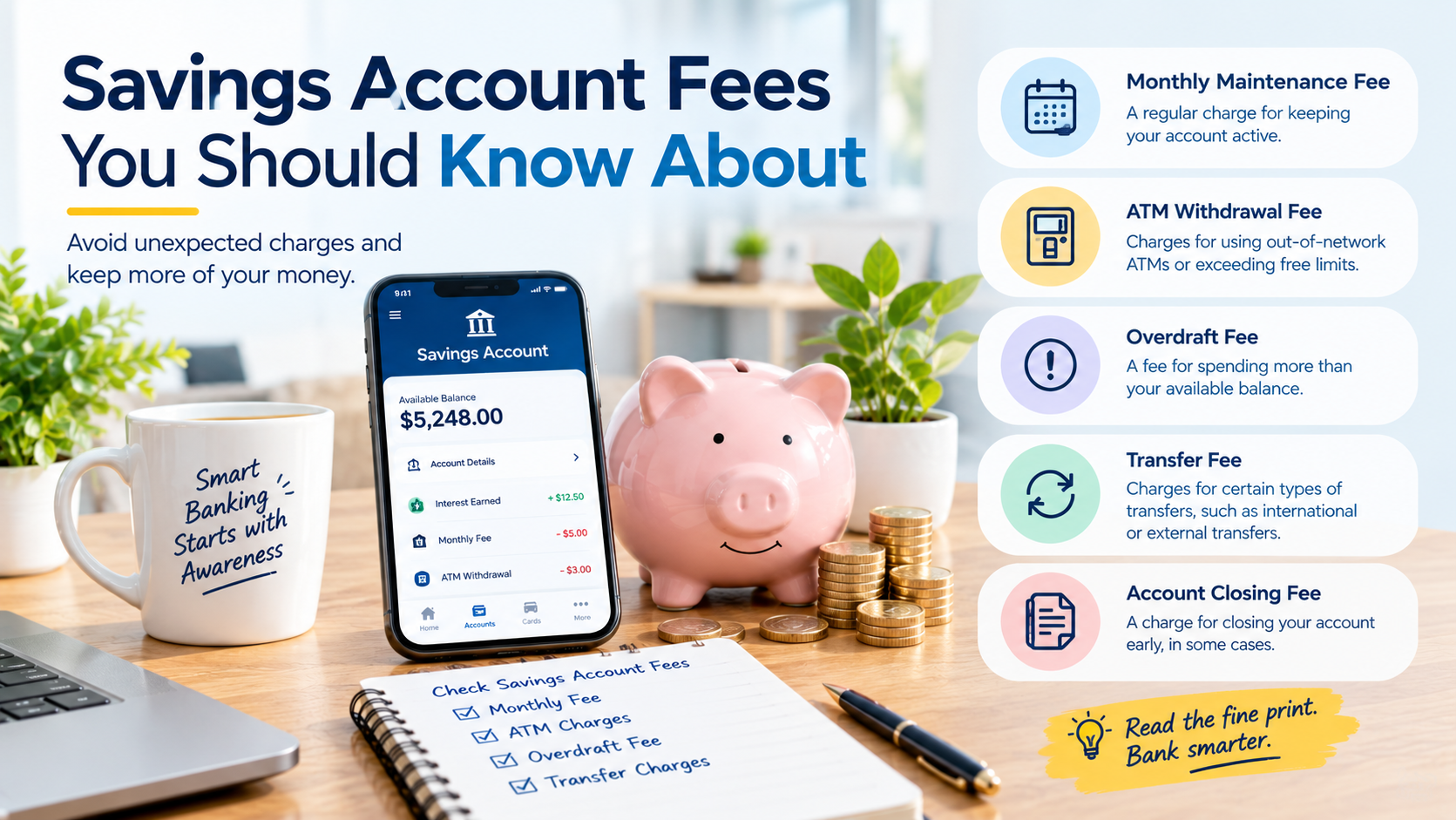
You open a savings account expecting it to quietly grow your money in the background. Then one day you check your balance and it’s a little lower than it should be, with no obvious reason why. Nine times out of ten, the culprit is a fee you never really noticed when you signed up. Banks are not exactly loud about these charges, they tend to sit in a terms and conditions document that almost nobody reads cover to cover.
The good news is that most savings account fees are avoidable once you know they exist. This guide walks through the common ones, why banks charge them, and what you can actually do to keep more of your money where it belongs, in your account.
Why Do Banks Charge Fees on Savings Accounts in the First Place?
It might seem odd that a bank charges you to hold your own money, but there’s a business logic behind it. Running a bank costs money: staffing branches, maintaining ATMs, processing transactions, and keeping systems secure around the clock. Interest paid out on deposits is one expense, but fees are another way banks recover operating costs and, frankly, generate extra revenue.
This doesn’t mean fees are something you just have to accept. Plenty of banks compete for your business precisely by cutting down on these charges, so being aware of what’s standard lets you negotiate, switch, or simply avoid triggering them in the first place.
Common Savings Account Fees to Watch Out For
1. Minimum Balance Fee
This is probably the most common charge people run into. Many savings accounts require you to maintain a minimum balance, sometimes called an Average Monthly Balance or Average Quarterly Balance depending on the bank, and if your balance dips below that threshold even briefly, you get hit with a penalty. The required minimum can range from a few hundred rupees at smaller or regional banks to several thousand at some private banks, and the penalty itself usually scales with how far below the minimum you fall.
What makes this one sneaky is that it’s calculated as an average over the period, not just your balance on a single day. So even if you had a good balance most of the month but withdrew a large amount near the end, you could still get charged. Checking your bank’s specific minimum balance rule, and setting a mental buffer above it, saves you from this one entirely.
2. Account Maintenance or Service Charges
Separate from the minimum balance penalty, some banks charge a flat maintenance fee just for keeping the account open and active, regardless of your balance. This is more common with accounts that come bundled with extra features, like a premium debit card, insurance cover, or priority customer service. If you’re not actually using those extras, you’re essentially paying for a bundle you don’t need.
3. ATM Withdrawal Charges
Most banks give you a set number of free ATM transactions each month, both at their own ATMs and at other banks’ ATMs. Once you exceed that limit, each additional withdrawal usually costs a flat fee, and the cost tends to be higher at a non-home-bank ATM than at your own bank’s machine. Balance inquiries and mini-statement requests at ATMs sometimes count toward this limit too, which catches people off guard since they don’t think of those as “transactions.”
If you tend to withdraw cash often, keeping track of how many free transactions you have left, or switching to a bank that offers unlimited free withdrawals, can meaningfully cut down on this cost over a year.
4. SMS and Alert Charges
Many banks now charge a small quarterly or annual fee for SMS alerts on your transactions, even though these alerts exist largely to protect you from fraud. It’s a strange one to charge for, but it’s become fairly standard across the industry. The amount is usually small individually, but it adds up, and some banks waive it automatically if you maintain their required minimum balance or opt for app notifications instead of SMS.
5. Cheque Book and Cash Transaction Charges
If you still use cheques, most banks give you a limited number of free cheque leaves per year, beyond which each additional cheque book costs a fee. Some banks also charge for cash deposits or withdrawals at the branch counter once you exceed a certain number of free transactions per month, especially for larger amounts. This mostly affects people running a small business or handling cash regularly, rather than typical salaried account holders.
6. Account Closure Fee
Closing a savings account too soon after opening it, often within six months to a year, can trigger a closure fee at some banks. This is meant to discourage people from opening and closing accounts purely to chase a sign-up bonus or promotional offer. If you’re planning to switch banks, it’s worth checking this fee first so it doesn’t eat into whatever you were trying to save by moving.
7. Dormant or Inactive Account Fee
If you stop using a savings account entirely, no deposits, no withdrawals, no transactions for an extended period, usually around a year, the bank may classify it as dormant and apply a fee, or in some cases restrict online access until you visit a branch to reactivate it. This is easy to forget about if you have an old account from a previous job or a student account you no longer use, so it’s worth periodically checking on any account you’re not actively using.
8. Fund Transfer Charges
While many digital transfer methods are free or very low-cost these days, some banks still charge for certain types of transfers, particularly larger ones processed through older systems, or transfers initiated at a branch counter instead of through the app or net banking. If you’re moving significant amounts of money, it’s worth checking whether a cheaper transfer method is available before defaulting to whatever option the teller suggests.
9. Duplicate Statement or Document Charges
Requesting a physical copy of an old statement, a duplicate passbook, or certain certificates from the bank often comes with a small fee, especially if the request goes back several months or years. Most of this is avoidable simply by downloading statements directly from the app or net banking portal, where they’re usually free and instantly available.
How to Avoid Most of These Fees
The good news is that almost every fee on this list has a straightforward workaround once you know it exists.
Start by actually reading your bank’s fee schedule, which is usually available on their website or app under something like “schedule of charges.” It sounds tedious, but five minutes here can save you a lot of unpleasant surprises later. Keep your balance comfortably above the minimum requirement rather than cutting it close, since even a brief dip can trigger a charge. Switch to e-statements and app-based notifications instead of SMS and printed documents wherever the bank allows it, since these are almost always free.
If you withdraw cash often, track your free ATM transaction limit, or consider a bank that offers more generous limits or none at all. Avoid closing new accounts too quickly, and if you do have old, unused accounts sitting around, either use them occasionally or formally close them properly instead of letting them turn dormant.
Finally, don’t be afraid to simply ask your bank. Many fees are negotiable or waivable, especially if you’ve been a long-standing customer, maintain a decent balance, or have multiple products with the same bank. A quick call or branch visit asking for a waiver works more often than people expect.
Zero-Fee and Low-Fee Accounts: Are They Really Free?
A growing number of banks, particularly newer digital-first ones, advertise zero-balance or low-fee savings accounts as a core selling point. These accounts genuinely do cut out many of the charges listed above, especially minimum balance penalties and maintenance fees, since digital banks save on the overhead of running branches.
That said, “zero fee” rarely means zero fees across the board. It’s worth checking whether ATM withdrawal limits, foreign transaction charges, or other smaller fees still apply, since banks have to recover costs somewhere. Reading the fee schedule remains worthwhile even for accounts marketed as free, just to confirm what’s actually included.
A Quick Checklist Before You Open Any Savings Account
Before signing up for a new savings account, it helps to ask a few direct questions. What is the minimum balance requirement, and how is it calculated? Is there a flat maintenance fee regardless of balance? How many free ATM withdrawals do you get, and what happens beyond that? Are SMS alerts charged separately, or can you switch to free app notifications instead? Is there a penalty for closing the account early, and what counts as “early”? And finally, what happens if the account goes unused for a while?
Running through this list takes a few minutes and can save you from discovering these answers the hard way, through a deducted fee on your statement.
Frequently Asked Questions
Why did my bank charge me even though I didn’t do anything unusual?
Most unexpected charges come from either falling below the minimum balance requirement or exceeding your free ATM withdrawal limit for the month. Checking your bank’s fee schedule usually clears up where the charge came from.
Can I get a bank fee reversed?
Often, yes, especially if it’s a one-time dip below the minimum balance or your first time triggering a particular fee. Contacting customer support or visiting a branch and asking directly works more often than people assume.
Are digital-only banks really free of these charges?
Many digital banks do waive the biggest fees, like minimum balance penalties and maintenance charges, but it’s still worth checking their fee schedule for smaller charges like ATM limits or foreign transaction fees.
Does every bank charge for SMS alerts?
Not every bank, and some waive it if you maintain the minimum balance or switch to app-based notifications instead. It’s worth checking your specific bank’s policy since this varies a fair bit.
What happens if I don’t use my savings account for a long time?
After a period of inactivity, usually around a year, the bank may mark it dormant, which can restrict some services or apply a fee until you reactivate it by visiting a branch or making a transaction.
Final Thoughts
Savings account fees aren’t designed to be secretive, but they’re definitely not advertised either, and that gap is exactly where most people end up losing money without realizing it. The fix isn’t complicated: read the fee schedule once when you open an account, keep half an eye on your balance and transaction limits, and don’t hesitate to ask your bank directly if a charge seems off. A little awareness here goes a long way toward making sure your savings account actually does what it’s supposed to, which is grow your money, not quietly chip away at it.