
You get paid, you cover the bills, and a few days later you wonder where the rest of your money went. It is one of the most common money frustrations in the USA, the UK and Germany. You are not careless. Most people simply never decide what their money should do before it gets spent.
Zero-based budgeting fixes that problem. It is a simple method where you plan every bit of your income before the month begins, so nothing is left to drift. In this guide, we will explain what zero-based budgeting is, how it works step by step, how it compares with other popular budgeting methods, and how to start even if you have never kept a budget before.
What Is Zero-Based Budgeting?
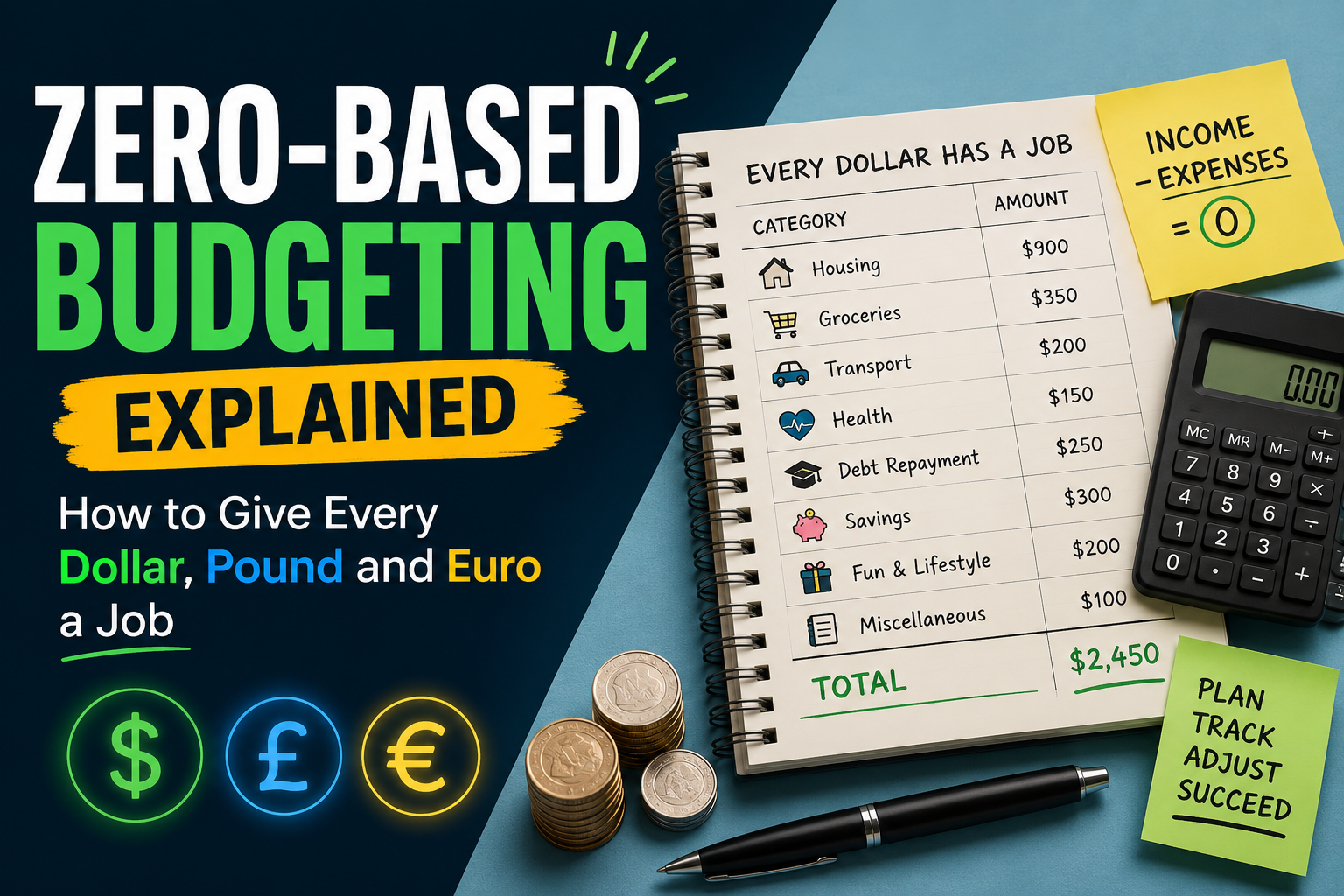
Zero-based budgeting means your income minus your planned spending and saving equals zero. Every dollar, pound or euro gets a specific job, whether that job is paying rent, buying groceries, building an emergency fund or covering a holiday.
The important thing to understand is that “zero” does not mean you spend everything or end the month with an empty account. Saving is one of the jobs. If you earn $3,500 and assign $500 to savings, that $500 is still a planned decision. It is just as intentional as your rent payment. The goal is that no money is left unassigned.
The idea is older than most budgeting apps. It started in the business world, where managers had to justify every expense from scratch instead of copying last year’s numbers. Peter Pyhrr developed the approach at Texas Instruments in the late 1960s, and it later spread to governments and companies. Personal finance writers adapted it for households, and today it is one of the most popular ways to take control of everyday money.
How Zero-Based Budgeting Works
Think of your income as a team of workers. Each unit of money needs an assignment. If you leave some money without a task, it tends to wander off into small impulse purchases, forgotten subscriptions or random card swipes.
With a zero-based budget, you sit down before the month starts and decide where each part of your income will go. Then you track your spending against that plan throughout the month. If you overspend in one category, you move money from another category to cover it. The total stays balanced, and you always know exactly where you stand.
This is quite different from traditional budgeting, where you set rough limits and check how you did at the end of the month. With zero-based budgeting, you make the decisions upfront, so there are fewer unpleasant surprises later.
Zero-Based Budgeting vs the 50/30/20 Rule
Many people ask how this method compares with the popular 50/30/20 rule. The 50/30/20 rule splits your after-tax income into three broad buckets: 50% for needs, 30% for wants and 20% for savings and debt. It is quick and easy, but it is also fairly general.
Zero-based budgeting is more detailed. Instead of three buckets, you create specific categories like rent, groceries, transport, dining out, holiday fund and car repairs. You can still use 50/30/20 as a starting guide to decide how much goes into each area, then break those amounts into exact figures.
If you want a fast, low-effort system, 50/30/20 may be enough. If you want more control, or if you feel like your money keeps slipping away, zero-based budgeting is usually the better fit.
How to Create a Zero-Based Budget Step by Step
The process is easier than it sounds. Here is how to build your first budget.
Step 1: Work Out Your Monthly Income
Start with your take-home pay, which is the amount that actually arrives in your bank account after tax and deductions. If you are paid monthly, this is simple. If you are paid weekly or every two weeks, add up what you will receive within the budget month.
If your income varies, as it does for freelancers, contractors and gig workers, use your lowest typical month as your base. Any extra money you earn on top can be assigned later, once it arrives. This keeps your plan realistic and avoids spending money you have not received yet.
Step 2: List All Your Expenses
Next, write down everything you spend money on. Look back at your last two or three bank statements to make sure you do not miss anything. Common categories include:
- Housing: rent or mortgage, council tax in the UK, property tax in the USA, utilities
- Food: groceries and eating out
- Transport: fuel, public transport, car insurance, parking
- Insurance: health, car, home or contents, liability
- Debt payments: credit cards, student loans, car finance
- Personal: phone, internet, subscriptions, clothing, haircuts
- Fun: hobbies, entertainment, hobbies and weekend trips
Do not forget the occasional costs. Many people forget about things like annual car tax, TV licence or broadcasting fees (the Rundfunkbeitrag in Germany), birthday gifts, car servicing and holiday spending. These do not happen every month, but they still need to be planned for.
Step 3: Assign Every Pound, Dollar or Euro
Now comes the heart of the method. Subtract your planned expenses and savings from your income until the number reaches zero.
Here is an example. Imagine you take home $3,600 a month in the United States:
- Rent and utilities: $1,400
- Groceries: $450
- Transport: $300
- Insurance and phone: $250
- Debt payment: $200
- Emergency fund: $400
- Retirement or investing: $200
- Fun and dining out: $250
- Irregular costs fund: $150
That adds up to $3,600, which leaves zero unassigned. Each category has a clear purpose, and you know exactly how much is available to spend in each one.
Step 4: Include Savings and Goals as Categories
This is where zero-based budgeting becomes powerful. Treat your savings goals like bills. An emergency fund, a house deposit, a new laptop and a holiday should each get their own line in your budget. When saving is part of the plan from day one, it stops being something you do only if there is money left over.
Step 5: Track Your Spending and Adjust
Once the month is underway, record your spending as it happens. You can do this with a spreadsheet, a notebook or an app. If you run out of money in one category, you have two choices. You can stop spending in that area, or you can move money from another category. What you cannot do is ignore it.
At the end of the month, review how it went. What did you overspend on? What did you underspend? Use that information to build next month’s budget. Over a few months, your numbers will become much more accurate.
A Real-Life Example in the UK and Germany
To show how flexible the method is, here are two more examples.
Sophie, 29, lives in Leeds. She takes home £2,300 a month. For years, she felt that her money disappeared by the 20th. When she tried zero-based budgeting, she discovered she was spending about £280 a month on takeaways and small shop visits without noticing. She assigned £120 to eating out and £60 to a monthly “treat” category, then moved the difference into an ISA. She still enjoys meals out, but now it is a decision instead of an accident.
Jonas, 33, lives in Hamburg. He earns €2,900 net. He uses zero-based budgeting to plan for larger annual costs such as car insurance, the Rundfunkbeitrag and his yearly holiday. He divides each annual bill by twelve and sets that amount aside each month in a separate savings pot. When the bills arrive, the money is already waiting. This removed the stress he used to feel every time a big payment came due.
Planning for Irregular and Annual Expenses
One of the biggest reasons budgets fail is that they ignore costs that do not occur monthly. A car repair, a vet bill or a Christmas season can wreck an otherwise solid plan.
The fix is to create what many people call sinking funds. A sinking fund is a small amount you set aside each month for a known future cost. If your car insurance is $1,200 a year, you save $100 a month for it. If you expect to spend £600 on Christmas, you put aside £50 every month starting in January.
Sinking funds fit perfectly into zero-based budgeting because they are just another category. They turn big, scary bills into small, predictable monthly amounts. Many people say this is the single feature that makes the method worth using.
Tools That Make Zero-Based Budgeting Easier
You can do zero-based budgeting with nothing more than a notebook and a calculator. A spreadsheet is even better, since it adds up everything for you. If you prefer an app, there are plenty of options.
In the USA and UK, apps such as YNAB (You Need A Budget), EveryDollar and Goodbudget are built around this approach. Banking apps with savings pots or spaces, like those offered by Monzo and Starling in the UK, are handy for separating money into categories. In Germany, many people use a classic Haushaltsbuch, either on paper or in a spreadsheet, and apps like Finanzguru can help with tracking spending.
Whichever tool you choose, pick something you will use consistently. A simple method you follow beats a fancy one you abandon after two weeks. Prices and features change over time, so check the current details before signing up for anything.
Pros and Cons of Zero-Based Budgeting
No budgeting method is perfect, so it helps to look at both sides.
The Benefits
The biggest advantage is control. You know where every part of your income goes, which makes it harder to waste money by accident. It also helps you notice spending patterns you would otherwise miss. Many people find hidden savings in the first month alone.
It also works well for goal setting. Since you must assign every unit of money, you naturally think about what matters most to you. People often discover that they can fund meaningful goals simply by redirecting small leaks.
Finally, it can reduce money anxiety. When you have a plan, you stop wondering whether you can afford something. You simply check the category.
The Drawbacks
The main downside is time. Zero-based budgeting asks for more effort than simpler methods, especially at the beginning. You need to plan at the start of each month and track spending along the way.
It can also feel strict. Some people feel restricted by having a limit on every category. If that sounds like you, include a flexible “fun money” or “miscellaneous” category so you have breathing room.
Variable income can also make planning harder, though using a conservative baseline helps a lot.
Common Mistakes to Avoid
Even a good system can go wrong if you fall into some common traps.
The first mistake is being too optimistic. If you budget £100 for groceries when you usually spend £400, the plan will collapse quickly. Base your numbers on what you actually spend, then improve gradually.
The second is forgetting irregular expenses. Annual bills and occasional costs can ruin a budget if they are not included. Always add sinking funds for them.
The third is giving up after one bad month. Your first budget will rarely be perfect. Expect to make adjustments, and treat each month as practice.
The fourth is skipping the tracking step. A budget on paper means little if you never check it against real spending. Spend a few minutes each week updating your numbers.
The last mistake is leaving no room for fun. A budget that allows no enjoyment is almost impossible to stick with. Plan some money for things that make you happy, and enjoy it without guilt.
Is Zero-Based Budgeting Right for You?
This method works best for people who want detailed control, who struggle to see where their money goes, or who are working toward a specific goal such as clearing debt or saving for a home. It is also helpful if your income is tight and every pound or dollar matters.
If you prefer a looser approach, you can still borrow ideas from it. For instance, you could plan only your main categories and let the rest flow into a single spending account. Budgeting is personal, and the best system is the one that fits your life.
Final Thoughts: Make Every Dollar, Pound and Euro Count
Zero-based budgeting is not about restriction. It is about intention. When you decide in advance what each part of your income will do, you spend with purpose, save with confidence and worry less about money.
Start small. Write down your income, list your expenses, assign every amount until you reach zero, and track how it goes. Your first budget will not be perfect, but your second will be better, and your third better still. Within a few months, you may be surprised by how much clearer your finances feel.
Pick a day this week, sit down with a coffee, and give every bit of your next paycheque a job. Your future self will thank you.